
-
 কর্তৃক Admin
-
 May 27, 2026
-
 Speaking
-
 0 মন্তব্য
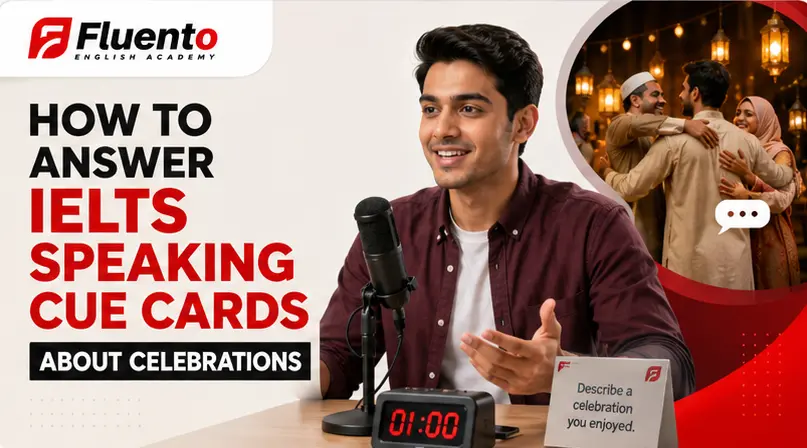
How to Answer IELTS Speaking Cue Cards About Celebrations
Celebration topics are common in IELTS Speaking practice because they allow you to describe people, places, feelings, traditions, and personal memories. For Bangladeshi learners, Eid can be a familiar example. But the goal is not to memorise one perfect Eid answer. The goal is to learn how to build a natural story.
An IELTS Speaking celebration cue card may ask you to describe a festival, a family event, or a celebration you enjoyed. Your answer becomes stronger when it has a clear shape: setting, event, feeling, and reflection.
Start with the setting, not the whole history
Many learners begin with too much background. They try to explain the full history of Eid or the full meaning of a festival. In Part 2, that can waste time. Start with the specific memory first.
For example: “I’d like to talk about an Eid celebration from last year, when most of my relatives came to our home in Dhaka.” This opening gives the examiner a clear time, place, and people. It also sounds personal, not memorised.
You can use the same method for any celebration. Say when it happened, where you were, and who was with you. The setting does not need to be dramatic. It only needs to help the listener understand the story.
Build the event with clear actions
After the setting, describe what happened. Use simple action verbs: prepared, visited, cooked, shared, travelled, greeted, decorated, enjoyed. Do not depend only on adjectives like “beautiful” and “amazing.” Actions make the story easier to follow.
For an Eid example, you might say: “In the morning, we visited my grandparents, and later everyone gathered for lunch. My cousins and I helped serve the food, and in the evening we took some family photos.” This is not complicated English, but it gives movement to the answer.
If the cue card asks “why it was memorable,” do not wait until the final sentence. Add small feelings throughout the answer. You can say you felt relaxed, connected, grateful, excited, or nostalgic. These words help you move from description to meaning.
Add reflection so the answer sounds mature
A strong Part 2 answer usually ends with reflection. This means you explain why the memory matters to you. Many learners stop after describing food, clothes, or travel. That can make the answer feel unfinished.
For example: “What made it special was that everyone was together after a long time. These days, people are often busy with work and study, so that Eid reminded me how important family time is.” This kind of ending is useful because it connects the event to a bigger idea.
Reflection does not mean using difficult vocabulary. It means showing thought. You can mention family bonding, tradition, childhood memories, or how celebrations are changing in modern life.
Practise without memorising full answers
Use this four-part structure for different cue cards: setting, event, feeling, reflection. Practise with Eid, a birthday, a wedding, a university programme, or a national celebration. Keep the structure, but change the details each time.
A useful practice method is to generate a random cue card, prepare for one minute, then speak for one to two minutes. Record your answer and listen for pauses, repeated words, and unclear grammar. For more practice, try the IELTS Speaking Question Generator and answer a new question each day.
The best IELTS cue card answers are not memorised speeches. They are clear personal stories. If you can organise a real memory and explain why it mattered, your answer will sound more fluent and more natural.
আমাদের নিউজলেটারে সাবস্ক্রাইব করুন
সরাসরি আপনার ইনবক্সে লেটেস্ট আপডেট, টিপস এবং তথ্য পান।


আরও পড়ুন


মন্তব্য করতে আপনাকে লগইন করতে হবে
সাম্প্রতিক পোস্ট


আপনাকে স্বাগতম
সাবস্ক্রাইব করুন আমাদের ভবিষ্যতের নিবন্ধগুলিতে!
সরাসরি আপনার ইনবক্সে লেটেস্ট ইংরেজি শেখার টিপস, এক্সক্লুসিভ কোর্স অফার এবং নতুন নিবন্ধের বিজ্ঞপ্তি পান।
মন্তব্য