
-
 কর্তৃক Admin
-
 May 29, 2026
-
 Reading
-
 0 মন্তব্য
How to Practise IELTS Reading with Short Texts During Busy Weeks
You do not need to complete a full IELTS Reading test every day to keep your reading skill alive. During Eid, family visits, travel, or a busy university week, a full one-hour practice session may feel unrealistic. That does not mean you should stop reading completely.
A short IELTS Reading practice routine can protect your vocabulary, focus, and comprehension without creating holiday fatigue. The goal is not to replace full test practice forever. The goal is to keep your brain connected to English so that restarting later does not feel painful.
Why short texts still build reading skill
Many learners think IELTS Reading practice only counts when they solve three long passages with a timer. Full tests are important, especially near the exam, but reading ability also grows from smaller controlled tasks. A 150-word article, a short news paragraph, a university notice, or a simple opinion piece can still train useful IELTS skills.
When you read a short text carefully, you practise identifying the topic, noticing keywords, following sentence connections, and checking meaning from context. These are the same skills you need in longer IELTS passages. Short reading is also easier to repeat consistently. If you miss practice for five days, you often feel guilty and avoid restarting. If your minimum task is only ten minutes, you are more likely to continue.
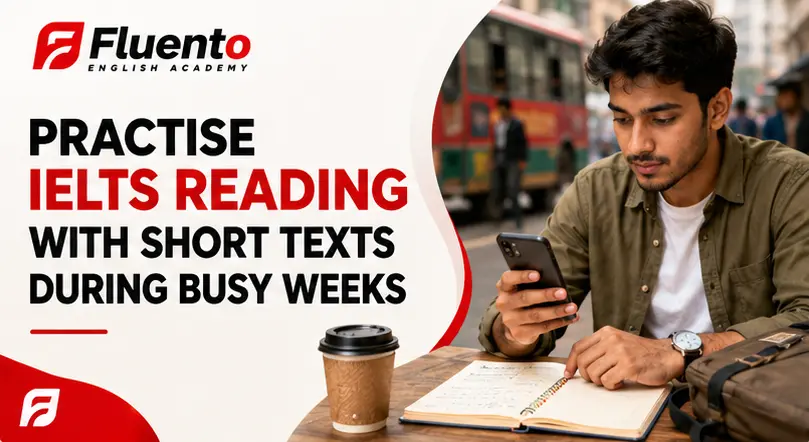
This is especially useful during Eid or any busy week in Bangladesh when your routine changes. You may not have a quiet desk, but you can still read one short text on your phone and do a focused task.
A 10-minute routine you can repeat
Use this simple routine when you do not have time for a full reading test:
- Read around 150 words.
- Write three keywords from the text.
- Write one sentence explaining the main idea.
- Answer two quick questions about details.
- Check one new word from context before using a dictionary.
For example, if you read a short article about public transport, your keywords might be “traffic,” “commuters,” and “cost.” Your main idea sentence could be: “The text explains why public transport is becoming more important in cities.” Then you can ask yourself two questions: What problem is mentioned? What solution does the writer suggest?
This routine trains both speed and understanding. It also stops you from reading passively. Many learners move their eyes across English sentences but cannot explain what they read. The three-keyword step forces you to decide what matters.
Keep the task small, but make it accurate
A short reading task is only useful if you do it with attention. Do not choose a difficult academic article and then panic. Start with a text you can understand at least 70 percent of without translating every line into Bangla. Your aim is controlled practice, not frustration.
After reading, review your mistakes honestly. Did you miss the main idea? Did you misunderstand a word? Did you answer from memory instead of the sentence? These small observations help you improve faster than simply reading more pages.
Once your normal routine returns, you can go back to full IELTS Reading passages and timed practice. Until then, let short texts keep your rhythm. A realistic IELTS routine is not about doing the biggest task every day. It is about choosing a task small enough to finish and focused enough to matter.
আমাদের নিউজলেটারে সাবস্ক্রাইব করুন
সরাসরি আপনার ইনবক্সে লেটেস্ট আপডেট, টিপস এবং তথ্য পান।


আরও পড়ুন


মন্তব্য করতে আপনাকে লগইন করতে হবে
সাম্প্রতিক পোস্ট


আপনাকে স্বাগতম
সাবস্ক্রাইব করুন আমাদের ভবিষ্যতের নিবন্ধগুলিতে!
সরাসরি আপনার ইনবক্সে লেটেস্ট ইংরেজি শেখার টিপস, এক্সক্লুসিভ কোর্স অফার এবং নতুন নিবন্ধের বিজ্ঞপ্তি পান।
মন্তব্য