
-
 কর্তৃক Admin
-
 Jun 22, 2026
-
 Vocabulary
 -
 0 মন্তব্য
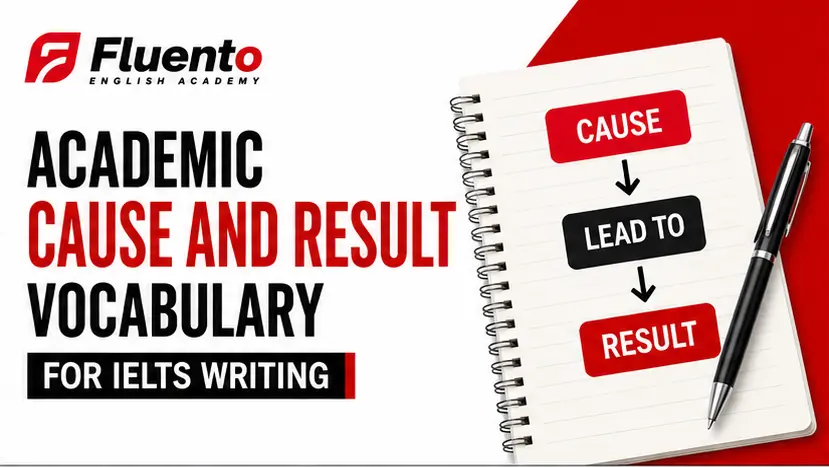
Academic Cause and Result Vocabulary for IELTS Writing
In IELTS Writing, many students repeat “because” again and again. There is nothing wrong with “because”, but stronger cause and result vocabulary IELTS learners should know includes verbs such as cause, lead to, result in, contribute to, and stem from.
These words help you explain relationships clearly. They are useful in Task 2 essays, especially for topics about education, technology, health, environment, traffic, employment, and social change. The key is not to memorise a list. You need to know the grammar pattern that follows each phrase.
Use cause and result verbs accurately
Some verbs move from cause to result. For example: “Poor planning can lead to wasted time.” The cause is poor planning. The result is wasted time. You can also write, “Traffic congestion results in longer commutes.” Again, the cause comes first and the result comes after the verb phrase.
Useful patterns include:
- cause + noun: “Air pollution causes health problems.”
- lead to + noun: “Lack of sleep can lead to poor concentration.”
- result in + noun: “Overuse of phones may result in reduced productivity.”
- contribute to + noun: “High rent contributes to financial pressure.”
Be careful with “result in” and “result from”. They are opposite directions. “Stress results in poor sleep” means stress causes poor sleep. “Poor sleep results from stress” means poor sleep is caused by stress.
Make your examples IELTS-friendly
Good vocabulary should make your meaning clearer, not heavier. Some learners write sentences that sound academic but are difficult to understand. For example, “Modern technology contributes to society in many sectors” is vague. What result are you explaining?
A clearer sentence would be: “Excessive screen time can contribute to weaker concentration among students.” This sentence has a clear cause, a clear result, and a realistic academic tone.
Here are a few more examples:
- “Limited access to quality education can lead to fewer job opportunities.”
- “Poor public transport often results in longer travel times.”
- “A lack of parental supervision may contribute to unhealthy online habits.”
- “Some health problems stem from poor diet and limited physical activity.”
Notice that the sentences are not complicated. The strength comes from accurate word choice and clear relationships.
Avoid grammar mistakes after these phrases
The phrase “lead to” is followed by a noun or noun phrase, not a full sentence. Write “lead to stress”, not “lead to students feel stress”. You can write: “Exams can lead to stress among students.”
The same applies to “result in” and “contribute to”. Use a noun phrase after them. If you want to use a full clause, use “because” or “as a result”. For example: “Students sleep less because they use phones late at night.” Or: “Students use phones late at night. As a result, they sleep less.”
Another common mistake is using too many cause-result phrases in one paragraph. If every sentence says “leads to” or “results in”, the paragraph becomes repetitive. Use one strong phrase where it matters, then explain the idea naturally.
Build vocabulary with patterns, not lists
When you learn a new academic verb, learn the full pattern with an example. Do not only write “contribute to = অবদান রাখা”. That translation is not enough for IELTS Writing. Learn it in a sentence: “Noise pollution contributes to stress in urban areas.”
You can make a small notebook with three columns: phrase, pattern, example sentence. Review the examples and write your own versions using common IELTS topics.
If vocabulary is your weak area, VocabPix Vocabulary App can help you learn words with examples, collocations, and context instead of memorising isolated translations. For IELTS Writing, that matters because the examiner reads how you use a word, not just whether you know its meaning.
Strong vocabulary is not about using the most difficult word. It is about choosing the right word, using the correct pattern, and making the relationship between ideas easy to understand.
আমাদের নিউজলেটারে সাবস্ক্রাইব করুন
সরাসরি আপনার ইনবক্সে লেটেস্ট আপডেট, টিপস এবং তথ্য পান।


আরও পড়ুন
মন্তব্য করতে আপনাকে লগইন করতে হবে
সাম্প্রতিক পোস্ট


আপনাকে স্বাগতম
সাবস্ক্রাইব করুন আমাদের ভবিষ্যতের নিবন্ধগুলিতে!
সরাসরি আপনার ইনবক্সে লেটেস্ট ইংরেজি শেখার টিপস, এক্সক্লুসিভ কোর্স অফার এবং নতুন নিবন্ধের বিজ্ঞপ্তি পান।
মন্তব্য