
-
 কর্তৃক Admin
-
 May 28, 2026
-
 Vocabulary
 -
 0 মন্তব্য
Useful Eid and Family Collocations in English
Many learners study vocabulary as single words: Eid, family, food, relatives, celebration. But natural English usually comes in word partnerships. These are called collocations. When you learn English collocations for Eid and family topics, your sentences sound smoother and less translated.
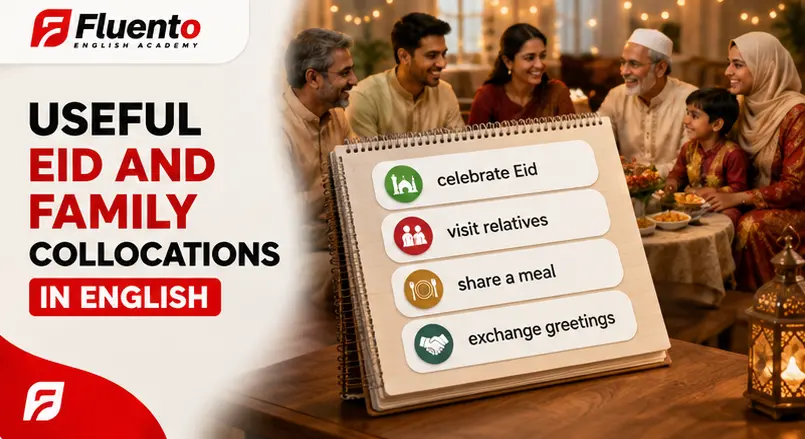
For example, we usually say “celebrate Eid,” “visit relatives,” “share a meal,” and “exchange greetings.” These phrases are more useful than memorising separate words because they show how English is actually used.
Collocations for Eid celebrations
Start with the most common verbs. You can celebrate Eid, observe Eid, enjoy Eid, or spend Eid with family. “Celebrate Eid” is the most common and flexible phrase. You can say: “We usually celebrate Eid with our relatives” or “Many families celebrate Eid by sharing food and visiting neighbours.”
For greetings, use “exchange greetings,” “send wishes,” or “wish someone Eid Mubarak.” For example: “After the prayer, people exchange greetings with friends and neighbours.” You can also say: “I sent Eid wishes to my teachers and colleagues.”
Be careful with direct translation. Instead of saying “give Eid greetings,” it is usually better to say “send Eid greetings” or “exchange Eid greetings.” Small word partners like this make everyday English sound more natural.
Family and visiting phrases
Eid often involves family visits, so these collocations are useful: visit relatives, gather with family, spend time with loved ones, host guests, welcome visitors, and attend a family gathering. You can write: “We visited our relatives in the afternoon” or “The whole family gathered for lunch.”
For food, use phrases like “share a meal,” “prepare traditional dishes,” “serve guests,” and “enjoy homemade food.” For example: “My mother prepared traditional dishes, and we shared a meal with our cousins.” This sounds more natural than listing food words without clear verbs.
If you are talking about memories, try “childhood memory,” “family tradition,” “special occasion,” and “festive mood.” These phrases help you speak about Eid in IELTS Speaking or everyday conversation with more detail.
Example sentences you can reuse
Here are some natural sentences built with collocations: “We usually celebrate Eid at my grandparents’ house.” “In the morning, we exchange greetings with neighbours.” “My cousins came over, and we shared a meal together.” “Eid is a special occasion because it brings the whole family together.” “I have many childhood memories of visiting relatives during Eid.”
Notice that none of these sentences use very difficult vocabulary. The strength comes from natural word combinations. This is why collocations are powerful: they make simple English sound fluent.
Try making your own sentences with these phrases. Write three about your family, three about food, and three about greetings. Then say them aloud. Speaking the collocations helps them become automatic.
Build vocabulary in phrases, not lists
If you only memorise single words, you may still struggle to use them in real sentences. Instead, learn each new word with a verb, adjective, or example sentence. For Eid topics, do not only learn “relative.” Learn “visit relatives.” Do not only learn “greeting.” Learn “exchange greetings.”
This habit is useful beyond Eid. IELTS Speaking and Writing both require flexible vocabulary, and collocations help you avoid awkward translation. If vocabulary is one of your weak areas, the VocabPix Vocabulary App can help you learn words with examples, context, and natural word partners.
The next time you prepare an Eid caption, message, or speaking answer, use collocations instead of isolated words. Your English will sound clearer, warmer, and more natural.
আমাদের নিউজলেটারে সাবস্ক্রাইব করুন
সরাসরি আপনার ইনবক্সে লেটেস্ট আপডেট, টিপস এবং তথ্য পান।


আরও পড়ুন
মন্তব্য করতে আপনাকে লগইন করতে হবে
সাম্প্রতিক পোস্ট


আপনাকে স্বাগতম
সাবস্ক্রাইব করুন আমাদের ভবিষ্যতের নিবন্ধগুলিতে!
সরাসরি আপনার ইনবক্সে লেটেস্ট ইংরেজি শেখার টিপস, এক্সক্লুসিভ কোর্স অফার এবং নতুন নিবন্ধের বিজ্ঞপ্তি পান।
মন্তব্য