
-
 কর্তৃক Admin
-
 Jun 04, 2026
-
 Listening
 -
 0 মন্তব্য
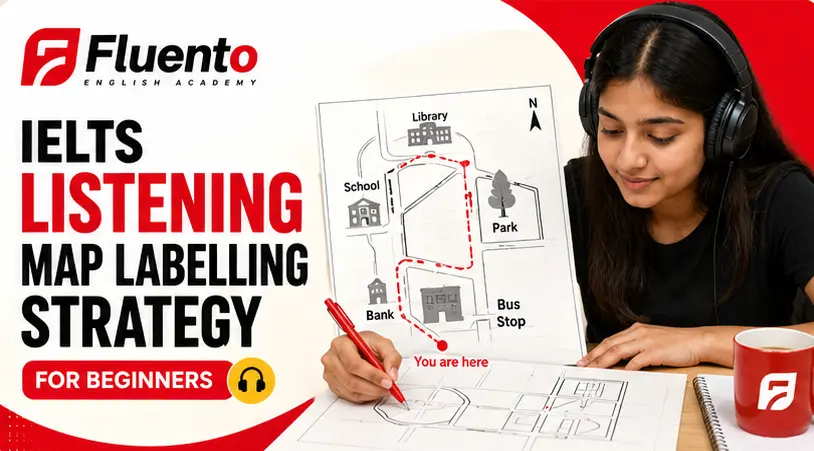
IELTS Listening Map Labelling Strategy for Beginners
IELTS Listening map labelling questions can feel confusing because you have to listen, follow directions, and look at a diagram at the same time. Many learners panic as soon as they see a map. Then they miss the first instruction, and the rest of the recording becomes harder to follow.
The key is not to understand every word. The key is to track the speaker’s movement from a starting point, listen for direction language, and connect landmarks on the map. With a clear method, map questions become much more manageable.
Study the map before the audio starts
Before the recording begins, look at the map carefully. Find the title if there is one. Is it a park, museum, campus, shopping area, or building floor plan? This gives you context. Then find the entrance, reception, main road, or “You are here” point. Most map questions start from a clear location, and missing that point is one of the biggest mistakes.
Next, notice the labelled places. The labelled places help you follow the route. If you see “library,” “café,” “car park,” or “main hall,” the speaker may use them as reference points. Also check the blank spaces. Are the answers on the left side, right side, near the entrance, or at the end of a path?
Do not spend this time trying to guess all answers. Your job before listening is to understand the layout so that the audio does not feel like a surprise.
Direction words you must recognise
Map labelling depends heavily on direction vocabulary. Common phrases include “next to,” “opposite,” “on the left,” “on the right,” “beside,” “at the end of,” “between,” “behind,” “in front of,” “go past,” and “turn left.” These words tell you where the answer is located.
For example, if the speaker says, “Go past the café, and the bookshop is on your right,” you should not choose the blank near the café before hearing the full direction. The café is only a landmark. The answer is the place on the right after passing it.
Be careful with correction language too. A speaker may say, “It used to be opposite the entrance, but now it is next to the information desk.” The first location is not the answer. Listen for words like “but,” “actually,” “now,” and “instead.” These signals often change the answer.
If you struggle with these phrases, practise them separately before solving full map questions. You cannot follow a map quickly if the direction words are still unfamiliar.
A step-by-step method during the test
When the audio starts, keep your pencil or finger near the starting point. Move along the map as the speaker moves. Do not jump ahead to a blank just because you hear a familiar word. Follow the route in order.
Listen for landmarks first, then the answer. If you lose your place, quickly return to a labelled landmark you recognise and continue from there. Do not stay stuck on one missed answer, because map questions often move quickly.
After the section, check spelling and word form. Map answers may be simple nouns, but they still need to be written clearly. If the answer is “bookshop,” writing “book shop” may or may not match the answer key depending on the test material, so copy carefully when options are given.
Map labelling is a listening and tracking task. Before the audio, understand the map. During the audio, follow the route. After the audio, check the answer form. This simple strategy can reduce panic and help you collect marks that many candidates lose unnecessarily.
আমাদের নিউজলেটারে সাবস্ক্রাইব করুন
সরাসরি আপনার ইনবক্সে লেটেস্ট আপডেট, টিপস এবং তথ্য পান।


আরও পড়ুন
মন্তব্য করতে আপনাকে লগইন করতে হবে
সাম্প্রতিক পোস্ট


আপনাকে স্বাগতম
সাবস্ক্রাইব করুন আমাদের ভবিষ্যতের নিবন্ধগুলিতে!
সরাসরি আপনার ইনবক্সে লেটেস্ট ইংরেজি শেখার টিপস, এক্সক্লুসিভ কোর্স অফার এবং নতুন নিবন্ধের বিজ্ঞপ্তি পান।
মন্তব্য