
-
 কর্তৃক Admin
-
 Jun 03, 2026
-
 Speaking
 -
 0 মন্তব্য
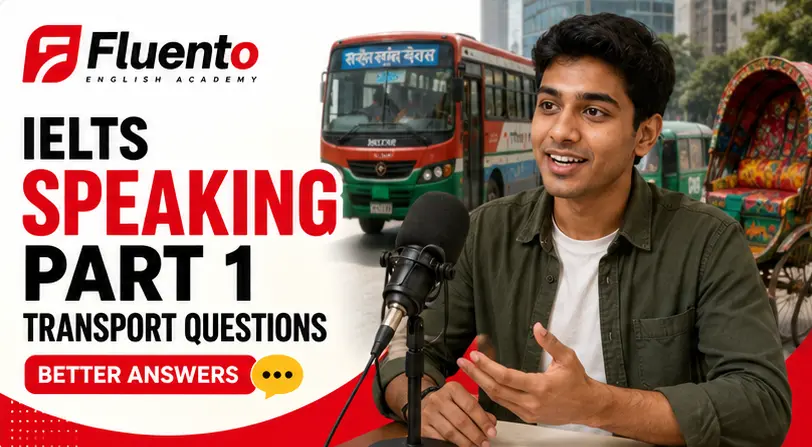
IELTS Speaking Part 1 Transport Questions with Better Answers
Transport is a common IELTS Speaking Part 1 topic because it connects to daily life. You may be asked how you travel around your city, whether you prefer public transport, or what problems people face on the road. The questions sound simple, but many learners give answers that are too short.
For IELTS Speaking transport questions, you do not need a long speech in Part 1. You need a short answer that is developed enough to sound natural. A one-word answer like “bus” or “rickshaw” does not show much English. A better answer adds a reason, frequency, contrast, or example.
Why “By bus” is not enough
Look at this question: “How do you usually travel around your city?”
Weak answer: “By bus.”
This answer is not grammatically wrong, but it is too limited. The examiner has almost nothing to assess. It also does not sound like normal conversation. In real life, if someone asks how you travel, you usually add a little context.
Better answer: “I usually take the bus because it is cheaper, although traffic can be frustrating during office hours.”
This answer is still short, but it gives more language. It includes frequency with “usually,” a reason with “because,” and contrast with “although.” These small additions make the answer stronger without turning it into a memorised paragraph.
For Bangladeshi candidates, local examples can be useful. You might mention buses, rickshaws, CNGs, ride-sharing, walking short distances, or traffic in Dhaka. Keep the examples natural and relevant to your own life.
Four easy ways to expand your answer
The first method is frequency. Say how often you use a form of transport: “I usually take the bus,” “I sometimes use ride-sharing apps,” or “I rarely travel by bicycle.” Frequency makes your answer more specific.
The second method is reason. Explain why: “because it is affordable,” “because it saves time,” or “because my university is not far from home.” This shows you can connect ideas.
The third method is contrast. Add a small positive-negative balance: “It is cheap, but it can be crowded,” or “It is convenient, although the fare is sometimes high.” Contrast helps your answer sound more mature.
The fourth method is example. You can say: “For example, I take a bus to university but use a rickshaw for short distances.” A simple example is often enough for Part 1.
Try combining only two of these at a time. If you use all four in every answer, you may sound mechanical.
Practise without memorising
Here are a few transport questions you can practise:
- How do you usually travel around your city?
- Do you prefer public transport or private transport?
- Is traffic a problem where you live?
- Did you travel by bus when you were a child?
- Would you like to cycle more often?
Record your answer and check whether it is too short, too long, or too memorised. A good Part 1 answer is usually two or three sentences. It should sound like you are speaking to a person, not reading from a script.
For more practice, try the IELTS Speaking Question Generator and answer one random question each day. If the topic is transport, use this pattern: answer directly, add a reason, and finish with a small example or contrast. Over time, this will help you speak more naturally about everyday topics.
আমাদের নিউজলেটারে সাবস্ক্রাইব করুন
সরাসরি আপনার ইনবক্সে লেটেস্ট আপডেট, টিপস এবং তথ্য পান।


আরও পড়ুন
মন্তব্য করতে আপনাকে লগইন করতে হবে
সাম্প্রতিক পোস্ট


আপনাকে স্বাগতম
সাবস্ক্রাইব করুন আমাদের ভবিষ্যতের নিবন্ধগুলিতে!
সরাসরি আপনার ইনবক্সে লেটেস্ট ইংরেজি শেখার টিপস, এক্সক্লুসিভ কোর্স অফার এবং নতুন নিবন্ধের বিজ্ঞপ্তি পান।
মন্তব্য