
-
 কর্তৃক Admin
-
 Jun 17, 2026
-
 Fluento Website Tools & Services
 -
 0 মন্তব্য
How IELTS Overall Band and Minimum Module Scores Work
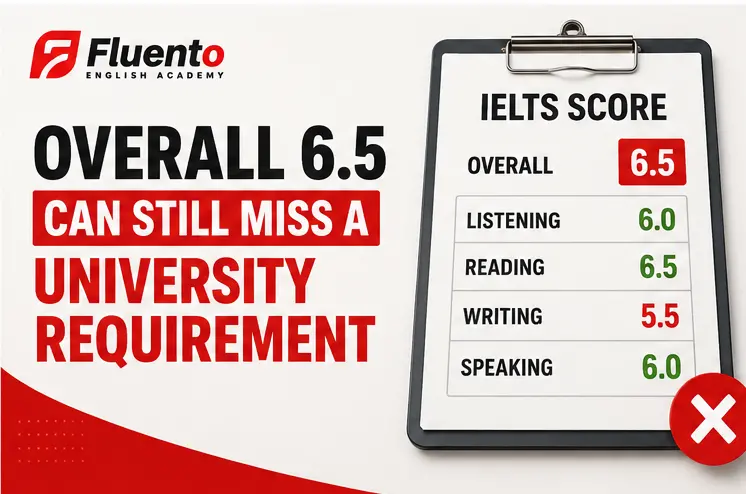
Many students focus only on the overall IELTS band. They say, “I need 6.5,” and start preparing without checking the full requirement. But an IELTS overall band and module score requirement may include both an overall score and minimum scores in Listening, Reading, Writing, and Speaking. That means overall 6.5 may still be insufficient if one module is too low.
For example, a learner may have an overall 6.5 but Writing 5.5. If the target institution requires no band below 6.0, the learner has not met the requirement. This is why score planning should look at both the total picture and the weakest module.
Overall score is not the whole story
Your IELTS result has four module scores: Listening, Reading, Writing, and Speaking. The overall band gives a summary of performance across the four modules. However, many universities, employers, or immigration pathways may also mention minimum module requirements. You should always check the exact requirement from the institution or programme you are applying to.
The mistake many learners make is studying for “overall 6.5” without asking, “Do I also need 6.0 in every module?” This matters because one weak skill can change your full preparation plan. If Writing is consistently lower than the other modules, your main problem is not the overall average. Your problem is the module minimum.
A good study plan should identify the weakest module early.
Why one weak module can change your plan
Imagine two learners. One has Listening 7, Reading 7, Speaking 6.5, and Writing 5.5. Another has all modules around 6.0 or 6.5. Both may talk about a similar overall target, but their preparation needs are different.
The first learner may need focused Writing correction, paragraph development, grammar accuracy, and Task Response practice. Taking more Listening tests will not fix the main gap. The second learner may need balanced practice across all modules.
This is why you should not only ask, “What band do I need?” Ask:
- What overall band is required?
- Is there a minimum score for each module?
- Which module is currently below the requirement?
- How much time do I have before the exam?
These questions turn IELTS preparation into a clearer plan.
Calculate before preparing blindly
If you have recent practice scores, write them down by module. Then compare them with the exact requirement you need. If you are unsure how your module scores connect to the overall band, use the IELTS Band Score Calculator to make the calculation easier.
The calculator is useful, but it should not replace checking your institution’s requirement. Treat it as a planning tool. It helps you see whether your current scores are close to the target and which module may need the most attention.
For example, if your Listening and Reading are strong but Writing is low, your next step should probably include Writing feedback or structured writing practice. If all modules are below the target, you may need a broader study plan.
Build your target around the requirement
A smart IELTS goal is specific. Instead of saying, “I need 6.5,” say, “I need overall 6.5 with no module below 6.0, and my current weak area is Writing.” That sentence gives direction.
Before you choose a course, mock test, or practice routine, check the module gap. A clear requirement helps you avoid wasting time on the wrong skill. Overall band matters, but the weakest module often decides what you should study next.
আমাদের নিউজলেটারে সাবস্ক্রাইব করুন
সরাসরি আপনার ইনবক্সে লেটেস্ট আপডেট, টিপস এবং তথ্য পান।


আরও পড়ুন
মন্তব্য করতে আপনাকে লগইন করতে হবে
সাম্প্রতিক পোস্ট


আপনাকে স্বাগতম
সাবস্ক্রাইব করুন আমাদের ভবিষ্যতের নিবন্ধগুলিতে!
সরাসরি আপনার ইনবক্সে লেটেস্ট ইংরেজি শেখার টিপস, এক্সক্লুসিভ কোর্স অফার এবং নতুন নিবন্ধের বিজ্ঞপ্তি পান।
মন্তব্য