
-
 কর্তৃক Admin
-
 Jul 01, 2026
-
 Fluento Website Tools & Services
 -
 0 মন্তব্য
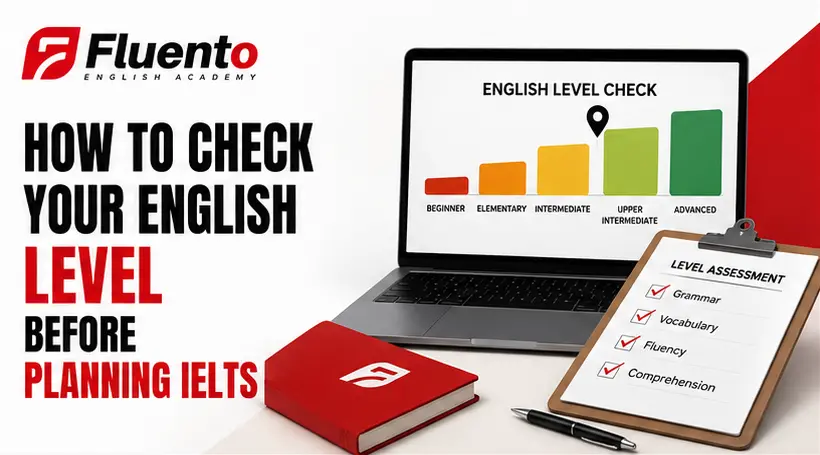
How to Check Your English Level Before Planning IELTS
You should check English level before IELTS preparation because IELTS is not only a test of tricks. It tests reading, writing, listening, speaking, grammar control, vocabulary, and your ability to use English under pressure. If your foundation is weak, jumping straight into IELTS question practice can feel frustrating.
A new month is a good time to plan, but planning should begin with diagnosis. Many learners choose a course, buy books, or start watching IELTS videos without knowing whether they are ready for IELTS-level study. The result is often confusion: the lessons feel too hard, the progress feels slow, and the learner starts thinking they are “bad at English.”
Why your current level matters
Your English level tells you what kind of study will help you most right now. A beginner may need sentence structure, basic grammar, everyday vocabulary, and confidence in simple speaking before IELTS strategy becomes useful. An intermediate learner may be ready for IELTS question types, but still need correction in writing and speaking.
For example, if you are around A2 level, your next goal may be controlling simple sentences accurately. You may need to practise subject-verb agreement, tense, articles, and basic speaking responses. If you are around B1 or above, your next goal may shift toward IELTS skills: paragraph writing, reading strategies, cue card speaking, and listening distractors.
Without level awareness, students often choose the wrong target. They may aim for IELTS band practice when the real need is Pre-IELTS foundation.
What a level check can show
A useful English level assessment should not only make you feel good or bad. It should help you understand your next step. It may show whether your grammar is weak, whether vocabulary is limited, or whether you struggle to understand longer English sentences.
The result should guide your decision. Some learners need Basic English support first. Some need Pre-IELTS bridging. Some are ready for IELTS preparation but need a structured plan. Others may already know the basics and mainly need feedback or mock tests.
This is why a level check is more practical than guessing. You are not trying to label yourself forever. You are trying to choose the right starting point for the next few months.
Check your level before choosing a routine
If you want a simple starting point, take the Free English Level Assessment Tool before making your IELTS plan. After that, look at your result honestly. Do not treat a lower level as failure. It simply means your preparation should begin earlier in the learning chain.
If your level is beginner or lower-intermediate, focus on sentence accuracy, listening to understandable English, reading short texts, and speaking in simple but correct answers. If your level is intermediate, start adding IELTS-style practice gradually. If your level is stronger, use mock tests and feedback to find specific score gaps.
The key is to match the routine to the learner, not to copy someone else’s plan.
Set one realistic target for the month
After checking your level, choose one main target for the month. A beginner target may be: “I will write accurate simple sentences using past and present tense.” A Pre-IELTS target may be: “I will read one short article every day and summarise it.” An IELTS target may be: “I will complete one Reading passage under time and review mistakes.”
This kind of planning is more useful than random motivation. IELTS preparation becomes easier when you know where you are starting from. Check your level first, choose the right path, and then build your study routine around the skills you actually need.
আমাদের নিউজলেটারে সাবস্ক্রাইব করুন
সরাসরি আপনার ইনবক্সে লেটেস্ট আপডেট, টিপস এবং তথ্য পান।


আরও পড়ুন
মন্তব্য করতে আপনাকে লগইন করতে হবে
সাম্প্রতিক পোস্ট


আপনাকে স্বাগতম
সাবস্ক্রাইব করুন আমাদের ভবিষ্যতের নিবন্ধগুলিতে!
সরাসরি আপনার ইনবক্সে লেটেস্ট ইংরেজি শেখার টিপস, এক্সক্লুসিভ কোর্স অফার এবং নতুন নিবন্ধের বিজ্ঞপ্তি পান।
মন্তব্য