
-
 কর্তৃক Admin
-
 Jun 10, 2026
-
 Speaking
 -
 0 মন্তব্য
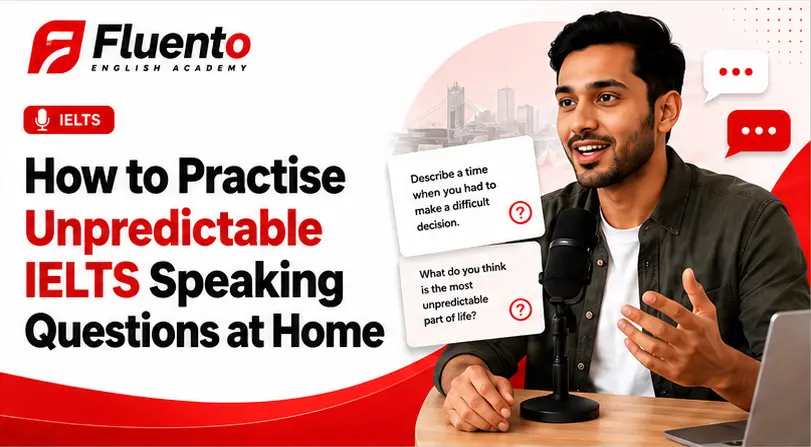
How to Practise Unpredictable IELTS Speaking Questions at Home
Many IELTS candidates practise only the topics they already know. They prepare answers about hometown, family, study, work, technology, and travel. Then in the real test, the examiner asks a follow-up question that feels slightly different, and the answer suddenly becomes weak. This is why practising IELTS Speaking random questions is useful.
Random questions train flexible thinking. They force you to understand the question, choose an idea quickly, and speak in your own words. This is very different from memorising a perfect answer. A memorised answer may sound smooth for one topic, but it often breaks when the examiner changes the direction.
Start with a short answer, not a perfect answer
When you practise at home, do not try to give a perfect one-minute answer immediately. Start with 30 seconds. Choose a random question, give yourself a few seconds to think, and answer naturally. For example: “What kind of public places do people in your city enjoy visiting?”
A simple answer may be enough at first: “In my city, many people enjoy visiting parks and shopping areas because they are easy places to spend time with friends. However, younger people may prefer cafés because they feel more comfortable and modern.”
This answer is not complicated, but it has a clear idea, a reason, and a contrast. That is already better than staying silent or forcing a memorised answer that does not match the question.
Use the record-listen-repeat method
Speaking practice becomes more useful when you record yourself. Many learners feel they are speaking well while answering, but when they listen later, they notice repeated problems: long pauses, unclear pronunciation, grammar slips, or weak vocabulary.
Use this simple routine:
- Pick one random speaking question.
- Answer for 30 to 45 seconds.
- Record the answer on your phone.
- Listen once for fluency and pauses.
- Listen again for grammar and vocabulary.
- Repeat the same answer with one improvement.
Do not try to fix ten things at once. If your first answer has many problems, choose one focus. Maybe you will reduce hesitation. Maybe you will correct verb tense. Maybe you will replace “good” with a more specific word like “useful”, “relaxing”, or “convenient”. Small focused improvement is more realistic than trying to sound advanced overnight.
Practise with unfamiliar topics
In IELTS Speaking, the topic itself is not always difficult. The difficulty comes from answering quickly and clearly. If you only practise familiar topics, you may become comfortable but not flexible. Random practice helps you face questions you did not prepare.
You can use the IELTS Speaking Question Generator to get unpredictable prompts and practise at home. Treat it like a mini examiner. Do not skip a question just because it feels difficult. Try to answer anyway, even if the answer is simple.
For Part 1, aim for direct answers with one or two extra details. For Part 2, practise organising your ideas with a beginning, two details, and a short ending. For Part 3, focus on explaining opinions instead of giving only examples.
When self-practice is not enough
Self-practice builds confidence, but it cannot always show you what you are missing. You may repeat the same grammar mistakes without noticing. You may also think your pronunciation is clear because you understand yourself.
If you want detailed correction, a Paid Speaking Mock Evaluation can help you understand repeated problems in fluency, pronunciation, grammar, and answer development. Use it after you have practised several random questions, not before you have tried speaking on your own.
The goal is not to memorise every possible IELTS question. The goal is to become comfortable answering questions you did not expect. That is what real speaking confidence looks like.
আমাদের নিউজলেটারে সাবস্ক্রাইব করুন
সরাসরি আপনার ইনবক্সে লেটেস্ট আপডেট, টিপস এবং তথ্য পান।


আরও পড়ুন
মন্তব্য করতে আপনাকে লগইন করতে হবে
সাম্প্রতিক পোস্ট


আপনাকে স্বাগতম
সাবস্ক্রাইব করুন আমাদের ভবিষ্যতের নিবন্ধগুলিতে!
সরাসরি আপনার ইনবক্সে লেটেস্ট ইংরেজি শেখার টিপস, এক্সক্লুসিভ কোর্স অফার এবং নতুন নিবন্ধের বিজ্ঞপ্তি পান।
মন্তব্য