
-
 কর্তৃক Admin
-
 May 24, 2026
-
 Listening
 -
 0 মন্তব্য
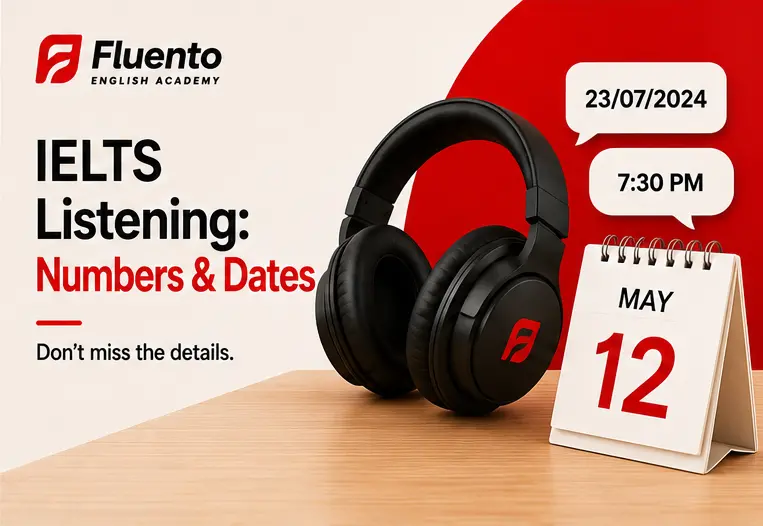
IELTS Listening Numbers and Dates: How to Avoid Common Answer Mistakes
IELTS Listening mistakes are not always caused by difficult vocabulary. Sometimes learners understand the conversation but lose marks because of small details: a number, a date, a spelling, a name, or a plural ending. These answers feel easy after you see the transcript, but they are easy to miss in real time.
That is why IELTS Listening numbers and dates need separate practice. You have to train your ear to catch exact details, not only general meaning. This skill is especially important for forms, notes, tables, bookings, addresses, and short-answer questions.
Numbers and dates need slow attention
Numbers can sound similar when you are nervous. "Fourteen" and "forty" are a common problem. So are "thirteen" and "thirty." The stress pattern is different, but learners often miss it because they are trying to understand the whole sentence at the same time.
Dates create another problem. "March 13" and "March 30" can be confused if you do not listen for the ending. Years, phone numbers, room numbers, prices, and times also need careful attention. When you practise Listening, do not only check whether your idea was correct. Check whether every digit was correct.
A useful habit is to repeat the number softly after you hear it during practice. Then write it. This trains your short-term memory and reduces panic.
Names and addresses test spelling
IELTS Listening spelling can be tricky because names and addresses may be spelled out quickly. A learner may hear the name correctly but write the wrong letters. For example, "Johnson" and "Jonson" are different answers. Double letters, silent letters, and unfamiliar names can create mistakes.
When practising, create a spelling list from your wrong answers. Do not only write the correct answer once. Say the letters aloud, copy the word three times, and then test yourself later. This is simple, but it builds accuracy.
Addresses also need attention. Street names, building names, and email addresses may include letters and numbers together. Keep your handwriting or typing clear during practice so you can review your own mistakes honestly.
Plural endings can change the answer
Plural endings are another common trap. If the answer is "books" and you write "book," the meaning is not exactly the same. The final /s/ can be very soft in fast speech, so you need to listen for grammar clues around the word.
For example, words like "several," "many," "two," or "a number of" often signal a plural noun. Verbs can also help. If you hear "the rooms are," the answer is likely plural. Do not guess blindly, but use grammar to support your listening.
This is where pronunciation and listening connect. If you often drop final sounds in your own speaking, you may also find them harder to notice when listening. Practising final sounds can improve both skills.
A self-practice checklist
After each Listening practice, review your wrong answers by type. Mark them as number, date, spelling, name, address, plural, or meaning problem. This turns a general weakness into a clear pattern.
Use this quick checklist: Did I hear the exact number? Did I confuse -teen and -ty? Did I write the full date correctly? Did I spell the name exactly? Did I check singular or plural? Did I copy the answer into the correct space?
Do not wait until a full mock test to practise these details. Spend five minutes a day with short audio clips, forms, or spelling exercises. Exact answers become easier when your ear expects them.
IELTS Listening rewards careful detail. Train yourself to hear numbers, dates, spellings, and endings with the same seriousness as main ideas. That small habit can protect many answers that learners often lose unnecessarily.
আমাদের নিউজলেটারে সাবস্ক্রাইব করুন
সরাসরি আপনার ইনবক্সে লেটেস্ট আপডেট, টিপস এবং তথ্য পান।


আরও পড়ুন
মন্তব্য করতে আপনাকে লগইন করতে হবে
সাম্প্রতিক পোস্ট


আপনাকে স্বাগতম
সাবস্ক্রাইব করুন আমাদের ভবিষ্যতের নিবন্ধগুলিতে!
সরাসরি আপনার ইনবক্সে লেটেস্ট ইংরেজি শেখার টিপস, এক্সক্লুসিভ কোর্স অফার এবং নতুন নিবন্ধের বিজ্ঞপ্তি পান।
মন্তব্য