
-
 কর্তৃক Admin
-
 Jun 19, 2026
-
 IELTS Writing Task 1
 -
 0 মন্তব্য
IELTS Process Diagram: How to Use Passive Voice Correctly
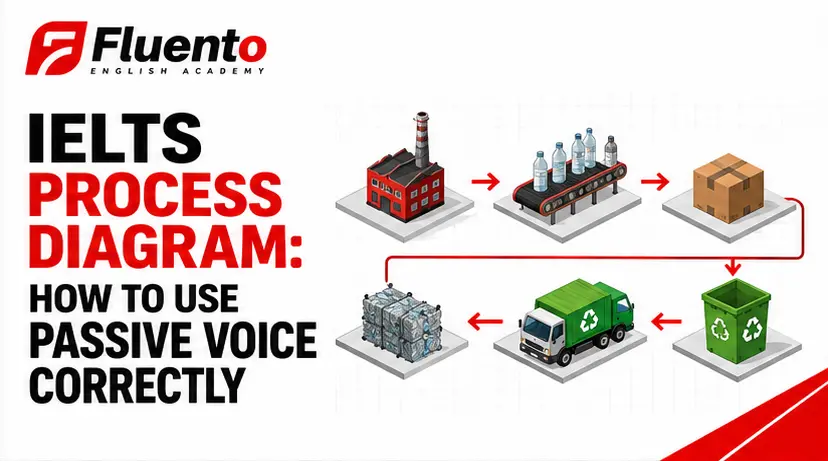
In IELTS Writing Task 1, process diagrams often show how something is made, produced, transported, recycled, or prepared. That is why IELTS process diagram passive voice is such an important skill. You are usually describing the process, not the person doing the action.
For example, instead of writing “Workers collect the milk from farms,” you can write, “The milk is collected from farms.” The second sentence sounds more suitable for a process diagram because the focus is on the step. In many diagrams, the actor is not shown or not important. The examiner needs to understand the order of the process clearly.
Why passive voice fits process diagrams
Passive voice helps you keep attention on the material, object, or product. In a tea production diagram, the leaves are picked, dried, packed, and transported. In a recycling diagram, bottles are collected, cleaned, melted, and remade. The sentence pattern stays clean because every step follows the same logic.
The basic structure is simple: subject + be verb + past participle. For present processes, use “is” or “are”: “The plastic bottles are collected.” For one item, use “is”: “The milk is heated.” For past processes, you may use “was” or “were”, but most IELTS process diagrams can be described in the present simple unless the diagram clearly shows a past situation.
Many learners lose control because they mix active and passive randomly. One sentence says “The factory heats the milk,” and the next says “It is then transported.” This is not always wrong, but it can make the report feel uneven. A consistent passive structure usually sounds more natural for process writing.
Use sequencing language, not only passive verbs
Passive voice alone is not enough. You also need to show the order of steps. Words and phrases like “first”, “next”, “after that”, “then”, “following this”, and “finally” help the reader follow the process.
Look at this simple example: “The milk is collected from farms. It is then transported to a factory. After that, it is heated and tested before being packaged.” The grammar is not complicated, but the order is clear. This is the main goal of Task 1 process writing.
Try not to start every sentence with “then”. If every line says “Then it is… then it is… then it is…”, the writing becomes repetitive. Use a mix of sentence patterns. For example: “Once the bottles have been cleaned, they are sent to the next stage.” This still uses passive voice, but the rhythm is better.
Common mistakes to avoid
One common mistake is using the base verb after “is” or “are”. For example, “The milk is collect from farms” is incorrect. You need the past participle: “The milk is collected from farms.” Similarly, write “is heated”, “is transported”, “is packaged”, “are washed”, and “are stored”.
Another mistake is overusing “by people” or “by workers”. If the diagram does not focus on who does the action, you usually do not need to mention it. “The fruit is washed” is enough. Adding “by workers” again and again makes the report heavy.
Also, do not describe every tiny arrow separately. Group related steps when possible. If a process has washing, cutting, and drying in sequence, you may write: “The vegetables are washed, cut into smaller pieces, and dried before being packed.” This shows better sentence control.
Practise with one process at a time
Take a simple process diagram and list the main verbs first: collect, heat, cool, pack, transport. Then change them into passive phrases: is collected, is heated, is cooled, is packed, is transported. After that, add sequencing language and write the paragraph.
If you keep making the same grammar or organisation mistakes in Task 1, detailed correction can help you see the pattern. You can submit a report for Paid Essay Feedback and check whether your passive voice, overview, grouping, and sentence flow are working together.
The goal is not to write difficult sentences. The goal is to describe the process clearly, logically, and accurately. Passive voice is useful because it helps you do exactly that.
আমাদের নিউজলেটারে সাবস্ক্রাইব করুন
সরাসরি আপনার ইনবক্সে লেটেস্ট আপডেট, টিপস এবং তথ্য পান।


আরও পড়ুন
মন্তব্য করতে আপনাকে লগইন করতে হবে
সাম্প্রতিক পোস্ট


আপনাকে স্বাগতম
সাবস্ক্রাইব করুন আমাদের ভবিষ্যতের নিবন্ধগুলিতে!
সরাসরি আপনার ইনবক্সে লেটেস্ট ইংরেজি শেখার টিপস, এক্সক্লুসিভ কোর্স অফার এবং নতুন নিবন্ধের বিজ্ঞপ্তি পান।
মন্তব্য