
-
 কর্তৃক Admin
-
 Jun 20, 2026
-
 Reading
 -
 0 মন্তব্য
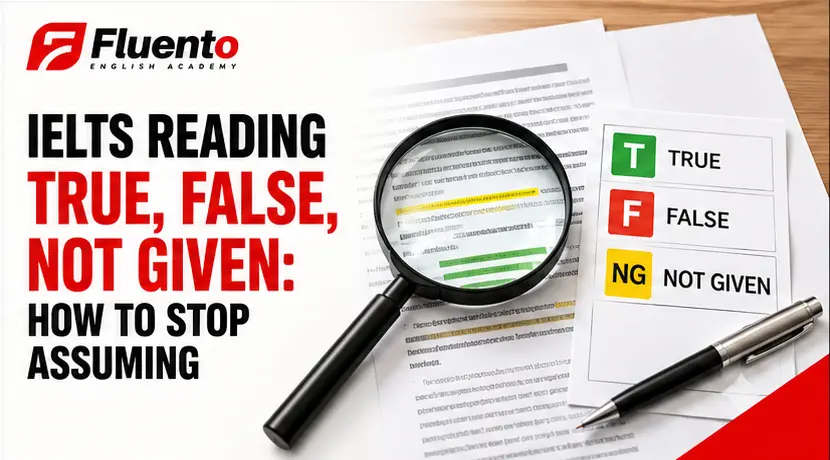
IELTS Reading True False Not Given: How to Stop Assuming
True, False, Not Given questions can feel confusing because the statement often looks logical. But IELTS Reading is not asking what is possible, normal, or likely. It is asking what the passage says. That is why good IELTS True False Not Given tips should focus on evidence, not guessing.
For example, the passage says: “The course started in 2024.” The statement says: “The course became popular in 2024.” Many learners choose True because the sentence feels connected. But “started” and “became popular” are not the same. If popularity is not mentioned, the answer is Not Given.
Read for meaning, not only matching words
A common mistake is searching for the same word and choosing quickly. IELTS often uses paraphrase. The passage may say “began”, while the statement says “started”. That can still match. But sometimes the words are similar while the meaning is different.
You need to compare the exact claim. Ask yourself: what is the statement saying? Is the passage saying the same thing, the opposite thing, or not enough to decide?
True means the passage clearly supports the statement. False means the passage clearly contradicts it. Not Given means the passage does not provide enough information. The hardest part is accepting “not enough information”. Many learners feel uncomfortable leaving a statement undecided, so they assume.
Watch for extra information in the statement
Not Given answers often include an extra idea. The passage may mention a person, date, place, or action, but the statement adds something more.
Passage: “The company opened a new branch in Chittagong.” Statement: “The company opened its largest branch in Chittagong.” The word “largest” is extra. If the passage does not compare branch sizes, the answer is Not Given.
Passage: “Students completed the assignment online.” Statement: “All students completed the assignment online.” The word “all” changes the claim. If the passage does not say every student did it, you cannot assume it.
Words like all, always, never, first, only, best, most, popular, successful, and cheapest can change the answer. Slow down when you see them.
Use a simple checking method
Try this three-step method. First, underline the main claim in the statement. Second, find the related part of the passage. Third, compare the meaning, not your background knowledge.
If you cannot point to a clear sentence or idea in the passage, do not choose True only because it sounds reasonable. Reasonable is not enough. IELTS Reading rewards passage-based accuracy.
This method also helps with timing. If you spend too long debating one question, mark it, move on, and return later. Sometimes the next statement helps you understand the same paragraph better.
Improve accuracy before speed
Many learners blame speed when the real problem is assumption. Reading faster will not help if you are reading carelessly. First, practise accuracy with untimed passages. After that, gradually add time pressure.
If you want to separate speed from understanding, the Reading Speed and Comprehension Checker can help you notice whether you are reading quickly but missing meaning. For more reading strategy support, you can also explore the Related Fluento Guide.
The key habit is simple: answer only from the passage. Not from logic, not from personal knowledge, and not from what usually happens. If the passage does not say it, Not Given may be the correct answer.
আমাদের নিউজলেটারে সাবস্ক্রাইব করুন
সরাসরি আপনার ইনবক্সে লেটেস্ট আপডেট, টিপস এবং তথ্য পান।


আরও পড়ুন
মন্তব্য করতে আপনাকে লগইন করতে হবে
সাম্প্রতিক পোস্ট


আপনাকে স্বাগতম
সাবস্ক্রাইব করুন আমাদের ভবিষ্যতের নিবন্ধগুলিতে!
সরাসরি আপনার ইনবক্সে লেটেস্ট ইংরেজি শেখার টিপস, এক্সক্লুসিভ কোর্স অফার এবং নতুন নিবন্ধের বিজ্ঞপ্তি পান।
মন্তব্য