
-
 কর্তৃক Admin
-
 May 16, 2026
-
 Speaking
 -
 0 মন্তব্য
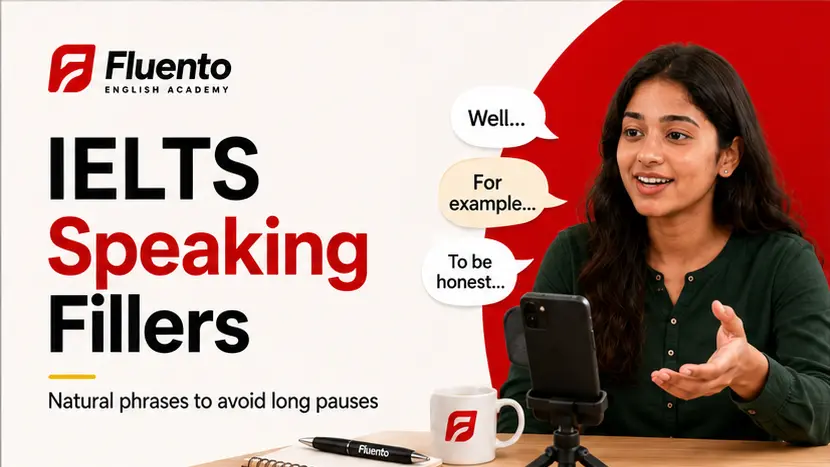
IELTS Speaking Fillers: Natural Phrases to Avoid Long Pauses
A short pause in IELTS Speaking can feel very uncomfortable, especially when your brain suddenly freezes. Many Bangladeshi learners become silent because they are trying to translate from Bangla, remember a memorised answer, or find a “perfect” word. IELTS Speaking fillers can help, but only when they sound natural and lead into a relevant answer.
A filler is not a trick to hide weak speaking. It is a short thinking phrase that gives you one or two seconds to organise your idea. Fluent speakers also use them in real conversations. The difference is that they do not use fillers as decoration. They use them briefly, then continue with a clear point.
Fillers should buy time, not replace the answer
Natural fillers are short, simple, and connected to the question. For example, “Let me think for a second,” “That’s an interesting question,” or “To be honest, I haven’t thought much about it” can sound normal if you continue immediately with an answer.
The problem starts when a learner memorises the same long phrase for every question. If you begin every answer with “Well, that is a very thought-provoking question and I would like to elaborate on it,” it starts to sound rehearsed. It also wastes time. A good filler should open the door to your answer, not become the answer itself.
For IELTS Speaking fluency, your goal is smooth continuation. A three-second thinking phrase followed by a relevant answer is better than a silent pause followed by panic. It is also better than a long memorised sentence that does not match the question.
Different parts need different phrases
Part 1 usually needs short, personal answers, so your fillers should stay light. If the question is, “Do you like shopping?” you might say, “To be honest, not that much. I usually shop only when I need something specific.” That sounds natural because the filler is short and the answer begins quickly.
Part 2 is different because you receive a cue card and need to speak for longer. Here, you can use phrases that help you introduce your topic: “One person who comes to mind is…” or “I’d like to talk about a place I visited recently.” These are not empty fillers; they help you start the answer clearly.
Part 3 often asks for opinion, comparison, or explanation. Useful phrases include, “That’s a broad question, but I think…” or “From my point of view, it depends on the situation.” These phrases give you thinking time while preparing the listener for a more developed answer.
Avoid the overused filler habit
Some learners use “actually,” “basically,” or “you know” too often. These words are not wrong, but repetition can make your answer sound weak. Another common habit is starting every answer with “In my opinion,” even when the question is personal or factual. For example, “In my opinion, my hometown is Dhaka” sounds unnatural because it is not really an opinion.
A better habit is to match the phrase to the question. Use “To be honest” for personal answers, “I suppose” for uncertain opinions, and “It depends” when there are two possible sides. This creates variety without forcing advanced vocabulary.
Practise fillers with real answers
Choose five IELTS Speaking questions and answer each one using one short filler only. Record yourself. Then listen and check two things: Did the filler sound natural? Did you continue with a clear answer within two or three seconds?
For example: “That’s an interesting question. I think public transport is useful in big cities because it reduces pressure on roads.” This is simple, but it works. The filler gives you a moment, and the answer still does the real job.
Fillers are helpful when they support communication. Use them to stay calm, organise your thoughts, and continue speaking. Do not use them to avoid answering. In IELTS Speaking, confidence comes from clear thinking, not from memorising impressive-sounding lines.
আমাদের নিউজলেটারে সাবস্ক্রাইব করুন
সরাসরি আপনার ইনবক্সে লেটেস্ট আপডেট, টিপস এবং তথ্য পান।


আরও পড়ুন
মন্তব্য করতে আপনাকে লগইন করতে হবে
সাম্প্রতিক পোস্ট


আপনাকে স্বাগতম
সাবস্ক্রাইব করুন আমাদের ভবিষ্যতের নিবন্ধগুলিতে!
সরাসরি আপনার ইনবক্সে লেটেস্ট ইংরেজি শেখার টিপস, এক্সক্লুসিভ কোর্স অফার এবং নতুন নিবন্ধের বিজ্ঞপ্তি পান।
মন্তব্য