
-
 কর্তৃক Admin
-
 Jun 16, 2026
-
 Speaking
 -
 0 মন্তব্য
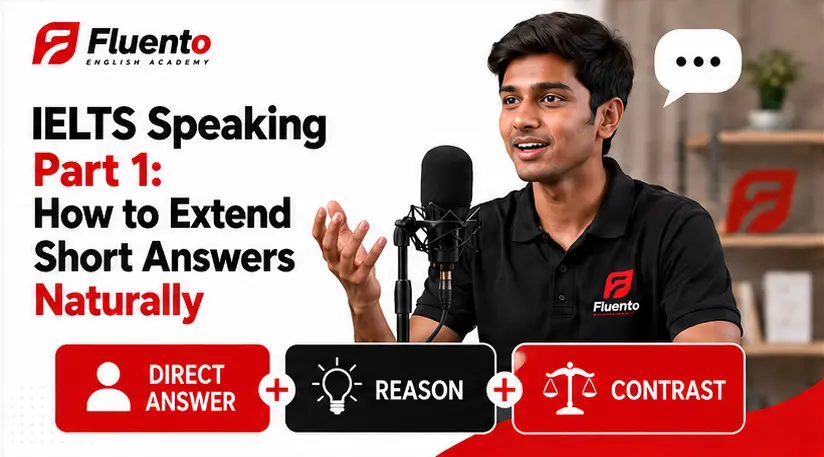
IELTS Speaking Part 1: How to Extend Short Answers Naturally
Many IELTS candidates give answers that are too short in Speaking Part 1. The examiner asks, “Do you like reading?” and the answer becomes, “Yes, I do.” That is not wrong, but it does not show much English. A simple IELTS Speaking Part 1 answer formula can help you extend your answer without memorising a long script.
The formula is: direct answer + reason + contrast. It works because Part 1 answers should be natural, clear, and not too long. You are not giving a speech. You are showing that you can respond comfortably.
Start with a direct answer
The first part should answer the question clearly. Do not begin with a long background story. If the question is “Do you like reading?”, start with “Yes, I do” or “Not really.” If the question is “Do you often use public transport?”, start with “Yes, quite often” or “No, not very often.”
A direct answer gives your response control. Some learners try to sound advanced from the first sentence and lose the point. The examiner should not have to guess your answer.
After the direct answer, add one reason. For example: “Yes, I do, because it helps me relax after a busy day.” Now the answer has a little development, but it still sounds natural.
Add contrast to sound more flexible
The third part is contrast. This is where many short answers become more interesting. Contrast means you add a small opposite or limitation using words like “but”, “however”, or “although”.
For example: “Yes, I do, because it helps me relax, but I usually read short articles when I’m busy.” This answer is simple, but it shows flexibility. You answered, explained, and added a realistic detail.
Here are more examples:
- “Yes, I like cooking because it feels creative, but I don’t cook much on weekdays.”
- “No, I don’t watch TV often because I prefer YouTube, although I sometimes watch news with my family.”
- “Yes, I enjoy travelling because I like seeing new places, but long journeys can be tiring.”
Notice that these answers do not use difficult vocabulary. The improvement comes from structure and natural development.
Do not turn Part 1 into a memorised speech
Some learners think longer answers are always better. That is not true. In Part 1, an answer that sounds memorised can feel unnatural. If the examiner asks a simple question, you do not need a one-minute response.
A good Part 1 answer usually has two or three sentences. It should be long enough to show language, but short enough to feel like a conversation. If you keep adding examples, stories, and advanced phrases, the answer may become heavy.
Also, do not use the same formula mechanically for every question. Sometimes direct answer + reason is enough. Sometimes direct answer + example works better. Use the formula as training wheels, not as a fixed script.
Practise with random questions
Take five random Part 1 questions and answer each using the formula. Record yourself and listen. Check whether the answer sounds natural or forced. If it sounds too long, reduce it. If it sounds too short, add one reason or contrast.
You can practise with the IELTS Speaking Question Generator and try different topics without preparing every answer in advance. Choose one question, answer for 20 to 30 seconds, then repeat with one improvement.
The goal is not to memorise perfect answers. The goal is to build a habit: answer clearly, explain briefly, and add a natural detail. That is how short Part 1 answers become stronger.
আমাদের নিউজলেটারে সাবস্ক্রাইব করুন
সরাসরি আপনার ইনবক্সে লেটেস্ট আপডেট, টিপস এবং তথ্য পান।


আরও পড়ুন
মন্তব্য করতে আপনাকে লগইন করতে হবে
সাম্প্রতিক পোস্ট


আপনাকে স্বাগতম
সাবস্ক্রাইব করুন আমাদের ভবিষ্যতের নিবন্ধগুলিতে!
সরাসরি আপনার ইনবক্সে লেটেস্ট ইংরেজি শেখার টিপস, এক্সক্লুসিভ কোর্স অফার এবং নতুন নিবন্ধের বিজ্ঞপ্তি পান।
মন্তব্য