
-
 কর্তৃক Admin
-
 May 09, 2026
-
 Grammar
 -
 0 মন্তব্য
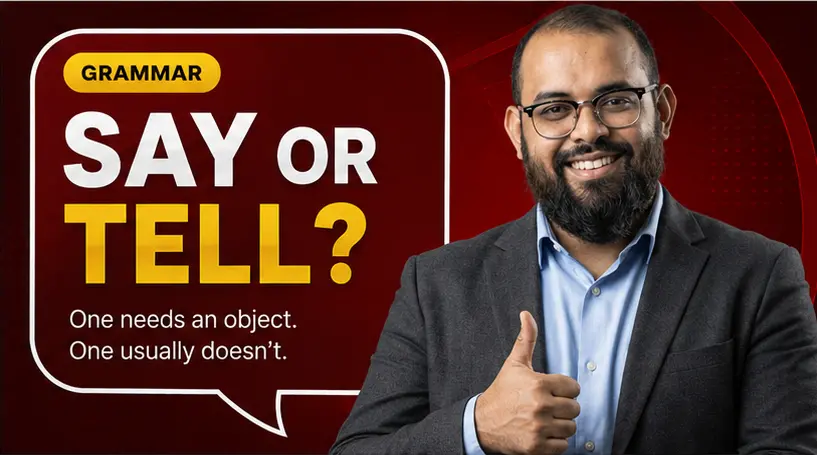
Say or Tell? A Simple Guide with Examples
Say and tell both connect to speech, so learners often mix them up. The easiest way to understand the difference is to learn the pattern after each verb.
Use:
- say something
- tell someone something
That means tell usually needs a person after it, but say usually does not.
How to Use Say
Use say when you focus on the words or message.
- She said the answer.
- He said he was busy.
- The teacher said we should practise more.
- I said sorry.
If you mention the listener after say, use to:
- She said to me that she was tired.
But in everyday English, this can sound a bit formal. Many speakers would simply say:
- She told me she was tired.
How to Use Tell
Use tell when you mention the person who receives the message.
- She told me the answer.
- My friend told me a funny story.
- The teacher told us to revise grammar.
- I told him the truth.
The pattern is important:
tell + person + message
So the sentence “She told the answer” feels incomplete because we expect a person after told.
Common Mistakes
Here are some common errors and corrections:
❌ She told that she was late.
✅ She said that she was late.
✅ She told me that she was late.❌ He said me the answer.
✅ He told me the answer.
✅ He said the answer to me.❌ My teacher said us to practise.
✅ My teacher told us to practise.
Practise with Real Answers
This grammar is useful in IELTS Speaking when you talk about advice, stories, teachers, family members, or past experiences.
Try making sentences like:
- My teacher told me to improve my pronunciation.
- My friend said the movie was interesting.
- My parents told me to study regularly.
For speaking practice, use the IELTS Speaking Question Generator, answer one question aloud, and notice where you use say or tell.
Final Advice
Do not only memorize definitions. Memorize the patterns. Say something and tell someone something will solve most common mistakes.
If you want feedback on grammar accuracy, fluency, and sentence control in your spoken answers, a Paid Speaking Mock Evaluation can be a helpful next step.
আমাদের নিউজলেটারে সাবস্ক্রাইব করুন
সরাসরি আপনার ইনবক্সে লেটেস্ট আপডেট, টিপস এবং তথ্য পান।


আরও পড়ুন
মন্তব্য করতে আপনাকে লগইন করতে হবে
সাম্প্রতিক পোস্ট


আপনাকে স্বাগতম
সাবস্ক্রাইব করুন আমাদের ভবিষ্যতের নিবন্ধগুলিতে!
সরাসরি আপনার ইনবক্সে লেটেস্ট ইংরেজি শেখার টিপস, এক্সক্লুসিভ কোর্স অফার এবং নতুন নিবন্ধের বিজ্ঞপ্তি পান।
মন্তব্য