
-
 কর্তৃক Admin
-
 Jun 08, 2026
-
 IELTS Writing Task 1
 -
 0 মন্তব্য
Than vs Then in IELTS Writing Task 1 Comparisons
Small word-choice mistakes can make an IELTS Writing Task 1 report look careless. One common example is confusing “than” and “then”. The words sound similar, but they do different jobs. If you are describing numbers, charts, or trends, the difference matters.
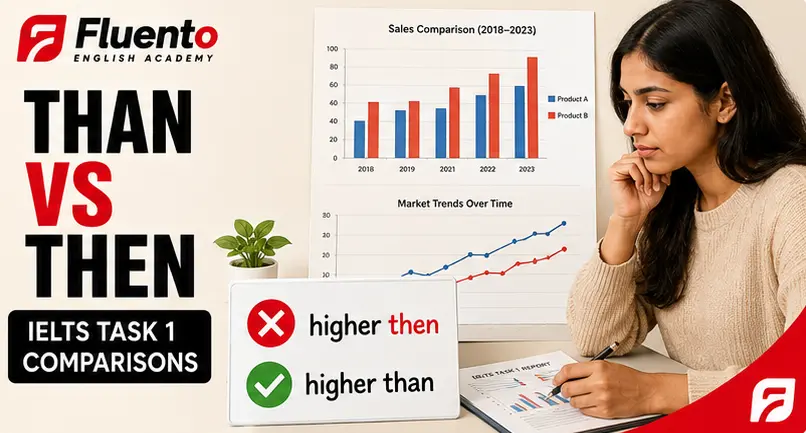
For than vs then IELTS practice, remember the simple rule: use “than” for comparison and “then” for time or sequence. In Task 1, comparisons are extremely common, so “than” appears much more often than “then”.
Use “than” when comparing numbers
In Writing Task 1, you often compare figures between cities, age groups, years, categories, or countries. Whenever you compare one number with another, use “than”.
Correct: “The figure for Dhaka was higher than the figure for Chattogram.”
Correct: “Women spent more time on household work than men.”
Correct: “The percentage of online shoppers was lower in 2010 than in 2020.”
The quiz sentence from the post is: “The figure for Dhaka was higher ___ Chattogram.” The correct answer is “than” because two figures are being compared.
Many learners write “higher then” because they are thinking of pronunciation, not meaning. In writing, that mistake is visible immediately. It may not destroy the whole report, but it weakens accuracy and can distract the reader.
Use “then” for time or sequence
“Then” is about order. It means after that, next, or at that time. You may use it in Task 1 if you are describing a process diagram or a sequence of stages.
Correct: “The water is heated and then passed through a pipe.”
Correct: “The mixture is cooled, then packed into containers.”
Correct: “In 2005, the number rose sharply. It then remained stable for five years.”
Notice that these examples are not comparing two numbers directly. They are showing what happens next. This is why “then” is more common in process descriptions than in bar charts, line graphs, or tables.
A useful test is to ask yourself: Am I comparing, or am I showing order? If you are comparing, choose “than”. If you are showing the next step, choose “then”.
Build better comparison sentences
Once you know the difference, practise using comparison language clearly. IELTS Task 1 grammar is not about using fancy sentences all the time. It is about describing data accurately.
Instead of writing: “Dhaka was high than Chattogram,” write: “The figure for Dhaka was higher than that for Chattogram.”
Instead of writing: “The number then India was lower,” write: “The number in India was lower than the number in Bangladesh.”
You can also avoid repetition by using “that of” or “those of” carefully. For example: “The figure for urban areas was higher than that for rural areas.” Use “that” for a singular figure and “those” for plural figures.
Before submitting a Task 1 report, scan for every use of “than” and “then”. Ask whether the sentence is comparing data or showing sequence. This 30-second check can remove a very noticeable mistake.
Good writing is often built from small accurate choices. “Than” and “then” may look like a minor issue, but Task 1 depends on comparison. If your comparison words are correct, your report becomes clearer and more professional.
আমাদের নিউজলেটারে সাবস্ক্রাইব করুন
সরাসরি আপনার ইনবক্সে লেটেস্ট আপডেট, টিপস এবং তথ্য পান।


আরও পড়ুন
মন্তব্য করতে আপনাকে লগইন করতে হবে
সাম্প্রতিক পোস্ট


আপনাকে স্বাগতম
সাবস্ক্রাইব করুন আমাদের ভবিষ্যতের নিবন্ধগুলিতে!
সরাসরি আপনার ইনবক্সে লেটেস্ট ইংরেজি শেখার টিপস, এক্সক্লুসিভ কোর্স অফার এবং নতুন নিবন্ধের বিজ্ঞপ্তি পান।
মন্তব্য