
-
 কর্তৃক Admin
-
 Jun 14, 2026
-
 Study Plan
 -
 0 মন্তব্য
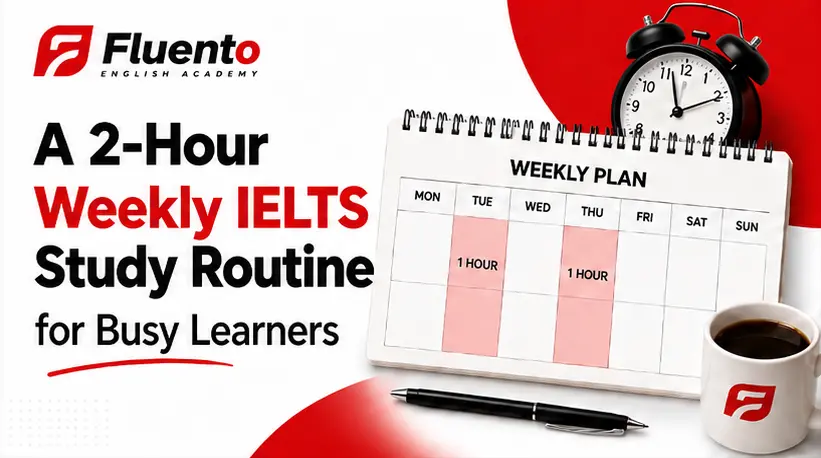
A 2-Hour Weekly IELTS Study Routine for Busy Learners
A full daily study plan sounds good, but many learners cannot follow it. University classes, office work, family responsibilities, and travel time can make IELTS preparation irregular. That is why an IELTS study routine for busy learners should be realistic first. If you cannot study for hours every day, one focused two-hour block each week can still give your preparation structure.
This routine is not meant to replace regular practice. It is a weekly reset. It helps you check where you are, practise one weak area, review mistakes, and decide what to do next. For many Bangladeshi learners, that is much better than randomly watching videos whenever panic starts.
Start with 30 minutes of diagnosis
Do not begin the study block by asking, “What should I study today?” Start by checking what needs attention. If you are still at the Basic English or Pre-IELTS stage, your diagnosis may be about grammar, vocabulary, sentence structure, or confidence. In that case, you can check your current level using the Free English Level Assessment Tool before building a heavier IELTS plan.
If you are already taking IELTS practice tests, use this first 30 minutes to review your latest module scores. Look at Listening, Reading, Writing, and Speaking separately. If you have raw Listening or Reading scores and want to understand the band gap, the IELTS Band Score Calculator can help you make the result easier to interpret. The goal is not to feel good or bad. The goal is to choose the right target for the next 90 minutes.
Spend 40 minutes on one weak skill
After diagnosis, choose only one weak skill. Do not try to fix Reading, Writing, Speaking, and vocabulary in the same session. If your Reading timing is weak, practise one passage or one question type. If Speaking Part 1 answers are too short, practise answer expansion. If Writing Task 2 is unclear, plan one essay before writing.
A focused 40-minute block should have a clear task. For example, “I will practise True/False/Not Given questions and review why my wrong answers are wrong.” That is much stronger than “I will do Reading.” Another example: “I will write one Task 2 introduction and two body paragraph plans.” This keeps your practice small enough to complete but serious enough to matter.
Busy learners often lose progress because they keep starting new materials. A two-hour routine works only when the skill practice is narrow.
Use 30 minutes to review mistakes
Practice without review can make the same mistakes stronger. After your weak-skill practice, spend 30 minutes checking what went wrong. Did you misunderstand the question? Did you lose time? Did you translate too much from Bangla? Did you use the same weak vocabulary again?
Write the mistakes in simple language. For example: “I read too slowly because I tried to understand every word.” Or: “My speaking answer had an idea, but no reason.” This kind of review turns IELTS preparation into data, not emotion.
If you only collect scores, you may feel stuck. If you collect mistake patterns, you can plan better.
Finish with a 20-minute plan for next week
The final 20 minutes should answer one question: what is the next useful action? Maybe you need a shorter daily reading habit. Maybe you need essay feedback. Maybe you need a mock test later. Maybe you are not ready for IELTS yet and need grammar foundation first.
Write one priority for the next week, not ten. For example: “Practise Speaking Part 1 with reason + contrast,” or “Review uncountable nouns in Writing.” You can also read more planning guides from Fluento’s article hub if you need ideas.
A two-hour weekly block will not magically solve IELTS. But it can stop your preparation from becoming random. For busy learners, consistency often begins with one honest weekly reset.
আমাদের নিউজলেটারে সাবস্ক্রাইব করুন
সরাসরি আপনার ইনবক্সে লেটেস্ট আপডেট, টিপস এবং তথ্য পান।


আরও পড়ুন
মন্তব্য করতে আপনাকে লগইন করতে হবে
সাম্প্রতিক পোস্ট


আপনাকে স্বাগতম
সাবস্ক্রাইব করুন আমাদের ভবিষ্যতের নিবন্ধগুলিতে!
সরাসরি আপনার ইনবক্সে লেটেস্ট ইংরেজি শেখার টিপস, এক্সক্লুসিভ কোর্স অফার এবং নতুন নিবন্ধের বিজ্ঞপ্তি পান।
মন্তব্য