
-
 কর্তৃক Admin
-
 Jun 14, 2026
-
 IELTS Writing Task 1
 -
 0 মন্তব্য
IELTS Bar Chart Writing: How to Group Categories Clearly
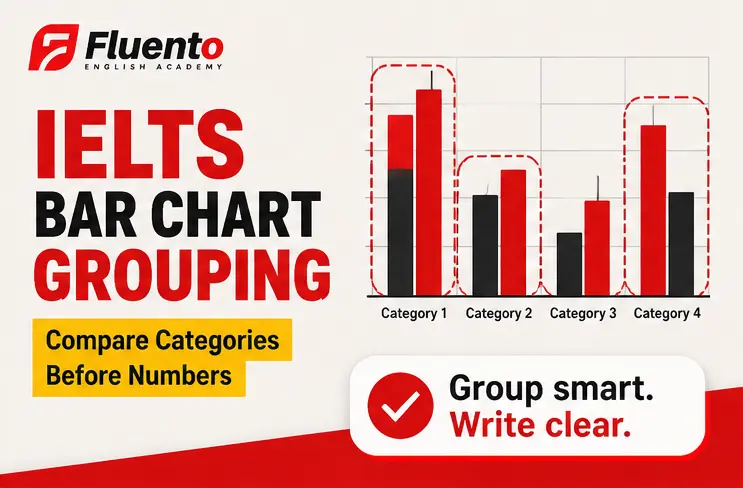
A common mistake in IELTS Writing Task 1 is describing every bar one by one. The report becomes long, repetitive, and hard to follow. Good IELTS bar chart grouping helps you compare categories before writing about numbers. Instead of treating each bar as a separate sentence, you look for patterns.
This skill matters because Task 1 is not just a number description exercise. You need to select and organise the main features. Grouping is one of the easiest ways to make your report feel organised.
Look for patterns before writing
Before you write the first sentence, study the chart for a minute. Ask yourself: Which categories are highest? Which are lowest? Are any categories similar? Is there a clear middle group? Are the differences large or small?
For example, imagine a bar chart with four categories: A and B are the highest, C is in the middle, and D is the lowest. A weak report may write four separate sentences: A was high. B was high. C was lower. D was the lowest. This is not completely wrong, but it feels mechanical.
A better report groups the information: “Categories A and B recorded the highest figures, while D had the lowest result. Category C remained between these two extremes.” This gives the reader a clearer picture.
Use groups to create stronger body paragraphs
Grouping helps you decide what each body paragraph should do. One paragraph can discuss the highest or most important categories. Another paragraph can discuss lower or contrasting categories. This is usually better than moving randomly from left to right across the chart.
Here are useful grouping options:
- highest vs lowest categories
- similar values together
- increase vs decrease, if time is shown
- male vs female, if the chart compares gender
- younger vs older groups, if age is shown
- main category vs exceptions
The best grouping depends on the chart. Do not force the same plan every time. Your job is to notice the chart’s strongest pattern.
A useful sentence pattern is: “X and Y showed similar figures, both standing at around…” Another is: “By contrast, Z was significantly lower…” These patterns help you compare instead of simply listing.
Avoid these common bar chart mistakes
Many learners make Task 1 harder by trying to mention every number. You do not need to report every detail. You need to report the main features and support them with selected data.
Avoid these habits:
- describing each bar in the exact order shown
- writing too many small numbers without comparison
- using “increased” or “decreased” when the chart does not show time
- missing the highest and lowest values
- writing an overview that is too vague
Your overview should show the big picture. For example: “Overall, categories A and B were the most popular, while D was the least common.” This is simple, but it tells the reader what the chart mainly shows.
A quick practice method
Take any IELTS bar chart and do not write the full report at first. Only write three things: the highest group, the lowest group, and one similarity or contrast. Then write a one-sentence overview. After that, plan two body paragraphs.
This short practice trains your eye to see structure before language. Once grouping becomes easier, writing the report becomes less stressful.
For more IELTS Writing and Task 1 support, you can read the Related Fluento Guide. When practising, remember this rule: compare first, describe numbers second. A grouped report usually sounds clearer than a list of disconnected bar descriptions.
আমাদের নিউজলেটারে সাবস্ক্রাইব করুন
সরাসরি আপনার ইনবক্সে লেটেস্ট আপডেট, টিপস এবং তথ্য পান।


আরও পড়ুন
মন্তব্য করতে আপনাকে লগইন করতে হবে
সাম্প্রতিক পোস্ট


আপনাকে স্বাগতম
সাবস্ক্রাইব করুন আমাদের ভবিষ্যতের নিবন্ধগুলিতে!
সরাসরি আপনার ইনবক্সে লেটেস্ট ইংরেজি শেখার টিপস, এক্সক্লুসিভ কোর্স অফার এবং নতুন নিবন্ধের বিজ্ঞপ্তি পান।
মন্তব্য