
-
 কর্তৃক Admin
-
 Jun 05, 2026
-
 Vocabulary
 -
 0 মন্তব্য
Climate Change Vocabulary for IELTS with Word Families
Climate and environment topics appear often in IELTS practice materials, but many learners memorise isolated words without learning how to use them. They know “pollution,” but not “pollute,” “polluted,” or “pollutant.” They know “sustainable,” but not “sustainability” or “sustain.” This limits both Writing and Speaking.
A better way to learn climate change vocabulary for IELTS is through word families. A word family shows different forms of the same idea: noun, verb, adjective, and sometimes person or thing. This helps you choose the right form in a sentence and avoid repeating the same word again and again.
Learn the family, not only the word
Start with common environment word families:
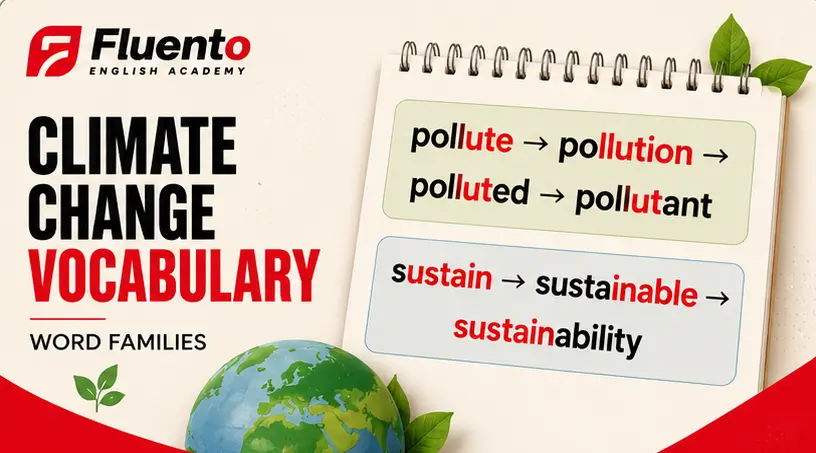
- pollute → pollution → polluted → pollutant
- sustain → sustainable → sustainability
- emit → emission → emitter
- conserve → conservation → conservative, where relevant to protection
- consume → consumption → consumer
- recycle → recycling → recyclable
These families are useful because IELTS questions may ask about causes, effects, solutions, or opinions. If you only know one form, your sentence choices become narrow.
For example, “Plastic causes pollution” is correct, but you can express the idea in different ways: “Factories pollute rivers,” “Polluted water affects public health,” or “Vehicle emissions are a major source of air pollution.” These sentence patterns show more flexibility.
Be careful with word form. “Pollution water” is wrong; say “polluted water.” “Sustainability development” is wrong; say “sustainable development.” This is why word families should be learned with example sentences, not just Bangla meanings.
Add collocations for natural IELTS sentences
Vocabulary becomes more useful when you learn collocations, which are words that commonly go together. For climate topics, useful collocations include “carbon emissions,” “renewable energy,” “single-use plastic,” “environmental damage,” “public awareness,” “waste management,” “green technology,” and “sustainable transport.”
Collocations help your writing sound more natural. Instead of writing “bad things for nature,” you can write “environmental damage.” Instead of “cars make smoke,” you can write “vehicles produce emissions.” The second version is more suitable for IELTS, but it is still clear.
Do not overload your essay with difficult vocabulary. One accurate collocation in the right place is better than five advanced words used incorrectly. Your goal is controlled vocabulary, not decoration.
Try making your own topic table with three columns: word family, collocations, and example sentence. For “consume,” you might write: “consumption,” “energy consumption,” and “Reducing energy consumption at home can lower pressure on natural resources.”
Practise vocabulary in sentences
The real test of vocabulary is whether you can use the word accurately in a sentence. Choose five climate words and write one IELTS-style sentence for each. Then check three things: Is the word form correct? Is the collocation natural? Does the sentence clearly connect to an idea?
For example:
“Governments should invest in renewable energy to reduce carbon emissions.”
This sentence works because the collocations are natural and the idea is clear. A weaker version would be: “Government should do renewable things for carbon.” The meaning is partly understandable, but the language is not controlled.
If vocabulary is your weak area, the VocabPix Vocabulary App can help you build words with visuals, examples, collocations, synonyms, antonyms, and word families. Use it to learn a small set of topic words deeply instead of memorising long lists that disappear after a few days.
For IELTS, climate vocabulary is not about sounding fancy. It is about explaining problems, causes, effects, and solutions with accurate words. Learn the family, practise the collocation, and use the word in a sentence before you trust it in an essay or speaking answer.
আমাদের নিউজলেটারে সাবস্ক্রাইব করুন
সরাসরি আপনার ইনবক্সে লেটেস্ট আপডেট, টিপস এবং তথ্য পান।


আরও পড়ুন
মন্তব্য করতে আপনাকে লগইন করতে হবে
সাম্প্রতিক পোস্ট


আপনাকে স্বাগতম
সাবস্ক্রাইব করুন আমাদের ভবিষ্যতের নিবন্ধগুলিতে!
সরাসরি আপনার ইনবক্সে লেটেস্ট ইংরেজি শেখার টিপস, এক্সক্লুসিভ কোর্স অফার এবং নতুন নিবন্ধের বিজ্ঞপ্তি পান।
মন্তব্য