
-
 কর্তৃক Admin
-
 Jun 23, 2026
-
 IELTS Writing Task 2
 -
 0 মন্তব্য
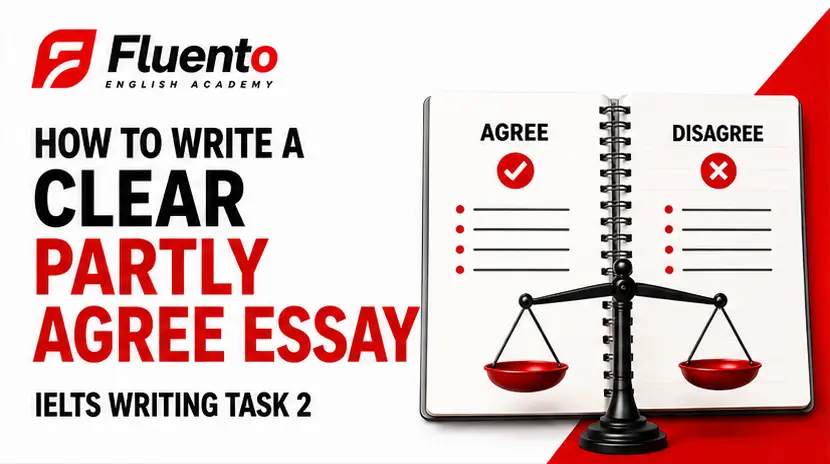
How to Write a Clear Partly Agree Essay in IELTS Writing Task 2
A partly agree essay IELTS answer can be strong, but only when your position is clear. Many students think “I partly agree” is a safe middle answer. The problem is that it often becomes vague: the essay agrees in one paragraph, disagrees in the next, and never explains the exact limit.
In IELTS Writing Task 2, partial agreement does not mean you are avoiding an opinion. It means your opinion has conditions. You agree with one part of the statement, but not completely. Your job is to show the examiner where you agree, where you disagree, and why that boundary makes sense.
A partial position still needs a clear thesis
A weak thesis says, “I partly agree because there are both advantages and disadvantages.” This sounds balanced, but it does not tell the reader what your real position is. It also makes the essay feel like a general discussion instead of an opinion essay.
A stronger thesis is more specific: “I partly agree because online learning is flexible for independent students, but classroom learning is better for learners who need direct feedback.” This sentence gives both sides, but it also controls the essay. One body paragraph can explain flexibility. The other can explain why weaker or less confident learners may need teacher support.
Before you write, complete this sentence: “I agree when…, but I do not fully agree because…” If you cannot complete it clearly, your essay plan is not ready yet.
Plan body paragraphs around the limit
For a partly agree essay, do not simply make paragraph one “agree” and paragraph two “disagree” without connection. The two paragraphs should work together to explain your exact view.
For example, imagine this topic: “Online education is better than classroom education.” A clear partial plan could be:
- Body 1: Online learning is useful for flexible revision and learners who can study independently.
- Body 2: Classroom learning is still better for students who need direct correction, speaking practice, and accountability.
Notice that this plan does not jump randomly between ideas. It compares learner situations. That makes the position mature and easier to follow.
Another useful pattern is “mainly agree, with one limitation.” For example, you may write that technology improves education in many ways, but it cannot fully replace teacher feedback. This allows you to show balance without weakening your answer.
Avoid sounding undecided
Some learners use too many soft phrases: “maybe”, “somehow”, “I think both are good”, “it depends on many things.” These phrases are not always wrong, but if you overuse them, your essay sounds unsure. IELTS does not require an extreme opinion, but it does require a controlled opinion.
Use clearer language instead: “I agree with this view to some extent.” Then explain the extent. You can write, “This is true for advanced learners, but not for beginners.” Or, “This is useful in theory, but difficult in poorer areas.” The key is to name the condition.
Also, do not add a third opinion in the conclusion. If your introduction says you partly agree, your conclusion should return to the same position. You can paraphrase it, but do not suddenly become fully agree or fully disagree at the end.
Practise with one prompt before writing a full essay
Choose one agree/disagree question and write only the thesis first. Then ask yourself: can a reader understand exactly what I agree with and what I limit? If the answer is no, rewrite the thesis before writing the full essay.
A good practice routine is to generate a random question, write two possible positions, and choose the clearer one. You can try this with the Essay Writing Practice Tool and focus only on your opinion statement for the first few attempts.
A clear partly agree essay is not about sitting on the fence. It is about showing judgment. When your thesis names the condition and your body paragraphs follow that condition, your answer becomes much easier to understand.
আমাদের নিউজলেটারে সাবস্ক্রাইব করুন
সরাসরি আপনার ইনবক্সে লেটেস্ট আপডেট, টিপস এবং তথ্য পান।


আরও পড়ুন
মন্তব্য করতে আপনাকে লগইন করতে হবে
সাম্প্রতিক পোস্ট


আপনাকে স্বাগতম
সাবস্ক্রাইব করুন আমাদের ভবিষ্যতের নিবন্ধগুলিতে!
সরাসরি আপনার ইনবক্সে লেটেস্ট ইংরেজি শেখার টিপস, এক্সক্লুসিভ কোর্স অফার এবং নতুন নিবন্ধের বিজ্ঞপ্তি পান।
মন্তব্য