
-
 কর্তৃক Admin
-
 Jun 23, 2026
-
 Fluento Website Tools & Services
 -
 0 মন্তব্য
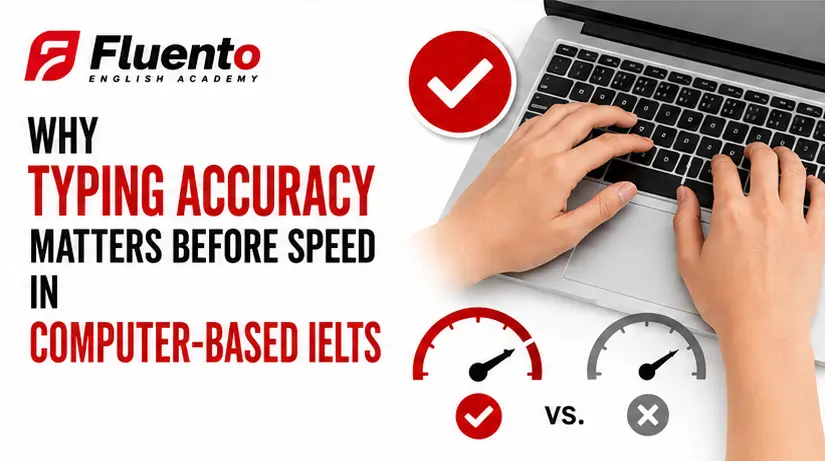
Why Typing Accuracy Matters Before Speed in Computer-Based IELTS
Many students preparing for computer-based IELTS worry about typing speed. Speed matters, but typing accuracy IELTS practice should come first. If you type fast but keep pressing backspace, correcting spelling, and fixing missing words, your actual writing flow becomes slow.
In the Writing test, you need to think, plan, type, edit, and manage time. If your fingers make constant mistakes, your brain gets interrupted. You stop thinking about ideas and start fighting the keyboard. That is why clean typing is more valuable than fast but messy typing.
Backspacing costs more time than learners realise
A typing mistake is not just one wrong letter. It can create a chain of interruptions. You notice the error, press backspace, retype the word, reread the sentence, and then try to remember what you were going to say next. This breaks concentration.
For example, if you type “goverment” every time and then correct it to “government”, the mistake may seem small. But if this happens twenty times in one task, your writing rhythm suffers. The same problem happens with capital letters, punctuation, spacing, and repeated spelling mistakes.
This is especially important for Task 2. You need mental energy for argument, examples, paragraphing, and grammar. If typing consumes too much attention, your essay quality may drop even when your English knowledge is better than your final writing.
Train accuracy before increasing words per minute
A useful goal is simple: clean accuracy first, then speed. Start by typing slowly enough to avoid unnecessary mistakes. Practise common IELTS words such as environment, education, government, technology, employment, development, advantage, disadvantage, and responsibility.
Do not only type random words. Type full sentences. IELTS writing is sentence-based, so your practice should include capital letters, commas, full stops, and paragraph spacing. For example: “Many students prefer online learning because it saves time and provides flexibility.” Type it carefully first, then repeat it slightly faster.
You can also practise copying one paragraph from an article. The goal is not to memorise the paragraph. The goal is to train your fingers to move accurately while your eyes follow sentence structure.
Build a weekly typing routine
You do not need hours of typing practice every day. A short routine can help if you do it consistently. Three or four days a week, spend ten minutes on accuracy drills and ten minutes on timed paragraph typing.
One simple routine:
- 5 minutes: common IELTS vocabulary typing
- 5 minutes: sentence copying with punctuation
- 10 minutes: type a short opinion paragraph under time pressure
After each session, check the mistake pattern. Are you missing capital letters? Are you spelling the same words wrongly? Are you typing too fast at the beginning and losing control later? This review is where improvement happens.
Practise in a test-like way
Computer-based IELTS preparation should feel comfortable before exam day. That does not mean you need to panic about typing. It means you should remove avoidable problems early.
You can use the Typing Practice Trainer to practise accuracy and gradually increase speed for computer-based IELTS writing. Start with clean typing, then build pace. If you already type quickly, use the practice to check whether your speed remains accurate under pressure.
The best typing practice does not only make you faster. It makes writing feel smoother. When your hands can type accurately, your mind has more space for planning, grammar, vocabulary, and clear ideas. That is what actually helps in the test.
আমাদের নিউজলেটারে সাবস্ক্রাইব করুন
সরাসরি আপনার ইনবক্সে লেটেস্ট আপডেট, টিপস এবং তথ্য পান।


আরও পড়ুন
মন্তব্য করতে আপনাকে লগইন করতে হবে
সাম্প্রতিক পোস্ট


আপনাকে স্বাগতম
সাবস্ক্রাইব করুন আমাদের ভবিষ্যতের নিবন্ধগুলিতে!
সরাসরি আপনার ইনবক্সে লেটেস্ট ইংরেজি শেখার টিপস, এক্সক্লুসিভ কোর্স অফার এবং নতুন নিবন্ধের বিজ্ঞপ্তি পান।
মন্তব্য