
-
 কর্তৃক Admin
-
 Jun 27, 2026
-
 IELTS Writing Task 1
 -
 0 মন্তব্য
IELTS Task 1 Map Vocabulary: Location and Change Phrases
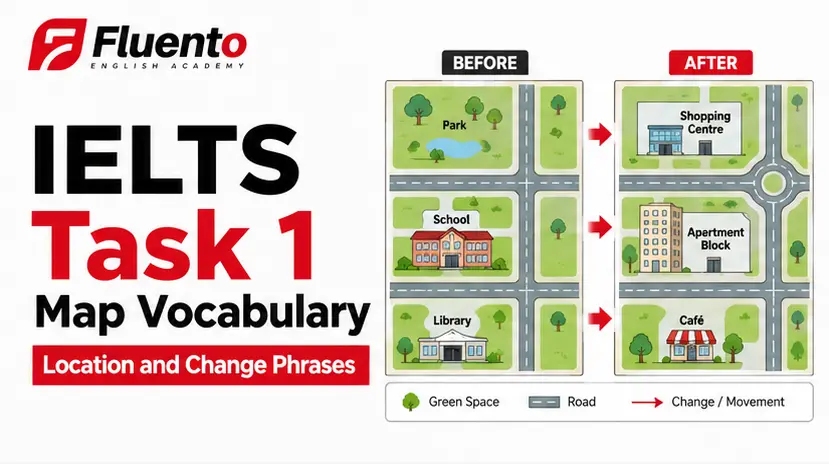
Good IELTS map vocabulary helps you describe location and change without sounding confused. In Writing Task 1 maps, you may need to compare two maps of the same place, describe new buildings, or explain how an area changed over time.
Many learners understand the map visually but struggle to write it. They repeat “there is”, “there was”, and “beside” again and again. A better approach is to learn map phrases in groups: location phrases, change verbs, and comparison sentences.
Start with accurate location language
Location phrases tell the reader where something is. Use phrases such as “to the north of”, “to the south of”, “in the centre of”, “on the eastern side”, “next to”, “opposite”, and “adjacent to.” These phrases make your description clearer than vague words like “here” or “there.”
For example, you can write, “The school is located to the north of the main road.” You can also write, “A car park was built adjacent to the shopping centre.” If two places face each other, use “opposite”: “The library is opposite the park.”
Be careful with direction. “North of the river” and “in the north of the town” are not exactly the same. The first compares position with another feature. The second describes an area inside the map. Small changes like this can make your writing more precise.
Use change verbs for before-after maps
When the map shows two different years, change language becomes important. Useful phrases include “was replaced by”, “was converted into”, “was transformed into”, “was demolished”, “was constructed”, “was extended”, and “remained unchanged.”
For example: “The park was replaced by a shopping area.” This sentence clearly shows what disappeared and what appeared. Another example: “The old factory was converted into an apartment block.” This shows that the original feature changed purpose.
Do not only list changes separately. Try grouping related changes. Instead of writing five short sentences, you might write: “The western side of the town became more commercial, as the park was replaced by shops and a new car park was added nearby.” This sentence compares the area as a whole.
Describe what did not change
Students often ignore unchanged features, but they can be useful in map reports. If the school, river, main road, or railway stayed the same, mention it when it helps the comparison. This shows that you can compare both change and stability.
Useful phrases include “remained unchanged”, “stayed in the same location”, and “continued to occupy the central area.” For example: “The school remained unchanged, while the area around it became more developed.” This sentence gives contrast and keeps the report organised.
However, do not mention every unchanged detail. Choose the major features that help the reader understand the overall development. Task 1 is not about describing every tree or tiny symbol. It is about selecting and summarising important information.
Practise with sentence groups
Before writing a full report, make three lists from the map: new features, removed features, and unchanged features. Then write five sentences using different phrase types: one direction phrase, one change verb, one comparison phrase, one unchanged feature, and one overall trend sentence.
For more IELTS Writing Task 1 practice, you can explore Fluento’s Related Fluento Guide page and study how different visual tasks need different language.
Map writing becomes easier when you stop memorising full reports and start controlling phrase groups. If your location language and change verbs are accurate, your report will sound clearer, more organised, and more confident.
আমাদের নিউজলেটারে সাবস্ক্রাইব করুন
সরাসরি আপনার ইনবক্সে লেটেস্ট আপডেট, টিপস এবং তথ্য পান।


আরও পড়ুন
মন্তব্য করতে আপনাকে লগইন করতে হবে
সাম্প্রতিক পোস্ট


আপনাকে স্বাগতম
সাবস্ক্রাইব করুন আমাদের ভবিষ্যতের নিবন্ধগুলিতে!
সরাসরি আপনার ইনবক্সে লেটেস্ট ইংরেজি শেখার টিপস, এক্সক্লুসিভ কোর্স অফার এবং নতুন নিবন্ধের বিজ্ঞপ্তি পান।
মন্তব্য