
-
 কর্তৃক Admin
-
 Jun 27, 2026
-
 Vocabulary
 -
 0 মন্তব্য
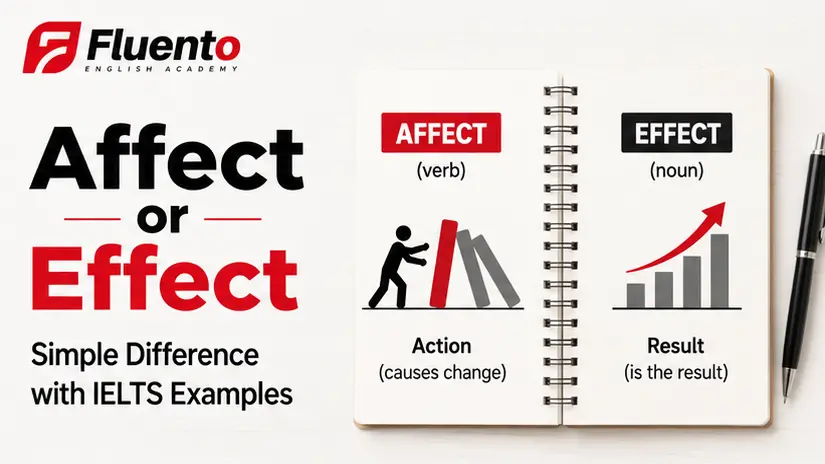
Affect or Effect: Simple Difference with IELTS Examples
The difference between affect vs effect confuses many English learners because the words look and sound similar. One letter changes the grammar. In most everyday and IELTS-style sentences, “affect” is a verb and “effect” is a noun.
A simple rule helps: if the blank needs an action, use “affect.” If the blank needs a thing, result, or impact, use “effect.” This is not the only grammar rule in advanced English, but it works for the majority of learner-level sentences.
Check the sentence position first
Look at this sentence: “The new routine can ___ your score.” After “can”, we need a base verb. So the answer is “affect”: “The new routine can affect your score.” You cannot write “can effect” in this common meaning.
Now look at another sentence: “The new routine had a positive ___ on his confidence.” After “a positive”, we need a noun. So the answer is “effect”: “The new routine had a positive effect on his confidence.”
This grammar-position check is more useful than memorising Bangla translations. Both words can feel like “প্রভাব” in Bangla, but English grammar decides which one fits. Ask yourself: is the word acting like a verb or a noun?
IELTS-style examples
In IELTS Writing, these words often appear in topics about education, technology, environment, health, and society. For example: “Excessive screen time can affect children’s concentration.” Here, “affect” is the action. Something is influencing concentration.
Now compare it with: “One major effect of excessive screen time is reduced concentration.” Here, “effect” means the result. The sentence is naming the outcome.
You can also write: “Air pollution affects public health.” That means pollution influences health. But you would write: “Air pollution has several harmful effects on public health.” Here, “effects” are the harmful results.
Notice the common patterns: affect + object, effect of something, effect on someone or something, harmful effects, positive effects, long-term effects. Learning these patterns is more useful than learning one word alone.
Common mistakes Bangla speakers make
One common mistake is writing “effect” after modal verbs: “This can effect students.” In most IELTS essays, this should be “This can affect students.” After can, may, might, should, and will, you usually need a verb form.
Another mistake is using “affect” after an article: “It had an affect on people.” This should be “It had an effect on people.” After “an”, you need a noun, and “effect” is the normal noun here.
Also, do not overuse these words in every sentence. If your essay repeats “affect” and “effect” too often, the writing becomes dull. Use related words when appropriate, such as “influence”, “impact”, “result”, “consequence”, “lead to”, and “cause.”
A quick practice task
Choose the correct word:
- Lack of sleep can ___ concentration.
- One serious ___ of pollution is illness.
- Teacher feedback can ___ writing accuracy.
- The new policy had a positive ___ on students.
The answers are: affect, effect, affect, effect.
If vocabulary pairs like this confuse you, practise them as word families and sentence patterns, not single translations. A tool such as the VocabPix Vocabulary App can help you connect words with examples, collocations, and context. You can also read more grammar and vocabulary lessons on Fluento’s Related Fluento Guide page.
The easiest way to choose is to slow down and check the grammar position. If it is an action, choose “affect.” If it is a result or noun, choose “effect.”
আমাদের নিউজলেটারে সাবস্ক্রাইব করুন
সরাসরি আপনার ইনবক্সে লেটেস্ট আপডেট, টিপস এবং তথ্য পান।


আরও পড়ুন
মন্তব্য করতে আপনাকে লগইন করতে হবে
সাম্প্রতিক পোস্ট


আপনাকে স্বাগতম
সাবস্ক্রাইব করুন আমাদের ভবিষ্যতের নিবন্ধগুলিতে!
সরাসরি আপনার ইনবক্সে লেটেস্ট ইংরেজি শেখার টিপস, এক্সক্লুসিভ কোর্স অফার এবং নতুন নিবন্ধের বিজ্ঞপ্তি পান।
মন্তব্য