
-
 কর্তৃক Admin
-
 Jun 28, 2026
-
 Fluento Website Tools & Services
 -
 0 মন্তব্য
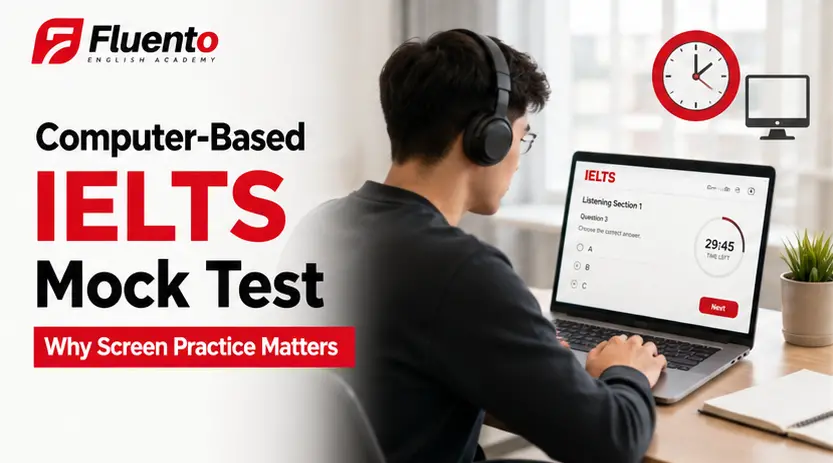
Computer-Based IELTS Mock Test: Why Screen Practice Matters
A computer based IELTS mock test is not only about checking your English level. It also shows whether you can manage the screen, timer, typing, navigation, and concentration for a long exam. Many students prepare with books and short practice tasks, then feel uncomfortable when they sit in front of a computer for the full test.
This does not mean computer-based IELTS is harder for everyone. It means the format has its own pressure. If you are not used to it, your performance may drop even when your English knowledge is better than your result.
Screen fatigue can affect performance
Reading from a screen for a long time feels different from reading from paper. Your eyes may get tired. You may lose focus during long passages. You may also feel pressure from the timer on the screen. These small things can affect your concentration.
In Writing, typing adds another layer. Some learners have good ideas but type slowly. Others type fast but make many spelling and punctuation mistakes. In Listening, you may need to move between questions quickly while staying with the audio. In Reading, you need to manage scrolling, highlighting, and answer transfer carefully depending on the interface.
A mock test helps you notice these issues before the real exam. It is better to discover screen fatigue during practice than on test day.
Mock tests reveal performance gaps, not just scores
A useful mock test is not just a number. It should help you ask better questions. Did you lose marks because you did not understand the passage? Did you run out of time? Did typing slow down your essay? Did you panic when the timer became low?
Two students can get the same score for different reasons. One may need more vocabulary. Another may need time management. Another may need to practise full-length concentration. If you only look at the band score, you may choose the wrong study plan.
After every mock, write down three things: where you lost time, where you felt mentally tired, and which question types caused the most mistakes. This turns the mock into a study guide instead of a one-day result.
Do not wait until the final week
Some students take a mock test only a few days before the exam. That may show the problem, but it gives very little time to fix it. If possible, take a computer-based mock early enough to adjust your preparation.
For example, if your Writing task 2 takes too long because of typing, you can build a short typing routine. If Reading feels slow on screen, practise reading passages digitally. If Listening distractors confuse you, practise full sections without pausing.
You can also use the Typing Practice Trainer separately if typing accuracy is a weak area. Speed is useful, but accuracy matters first. Rewriting misspelled words again and again wastes time during the exam.
Practise the environment before test day
A simulated Computer-Based IELTS Mock Exam Portal can help you experience the exam format more realistically. You practise under timing pressure, on a screen, with the kind of focus required for the real test environment.
This is not about fear. It is about familiarity. The more familiar the format feels, the more attention you can give to the actual English tasks. You do not want to spend exam day learning how to handle the screen.
A mock test cannot replace learning, feedback, or regular practice. But it can show whether your preparation works under pressure. That makes it one of the most useful steps before a computer-based IELTS exam.
আমাদের নিউজলেটারে সাবস্ক্রাইব করুন
সরাসরি আপনার ইনবক্সে লেটেস্ট আপডেট, টিপস এবং তথ্য পান।


আরও পড়ুন
মন্তব্য করতে আপনাকে লগইন করতে হবে
সাম্প্রতিক পোস্ট


আপনাকে স্বাগতম
সাবস্ক্রাইব করুন আমাদের ভবিষ্যতের নিবন্ধগুলিতে!
সরাসরি আপনার ইনবক্সে লেটেস্ট ইংরেজি শেখার টিপস, এক্সক্লুসিভ কোর্স অফার এবং নতুন নিবন্ধের বিজ্ঞপ্তি পান।
মন্তব্য